Inferring the mass of the circumgalactic medium using X-ray resonant scattering

Inferring the mass of the circumgalactic medium using X-ray resonant scattering
Nhut Truong, Maxim Markevitch, Dylan Nelson, Chris Byrohl
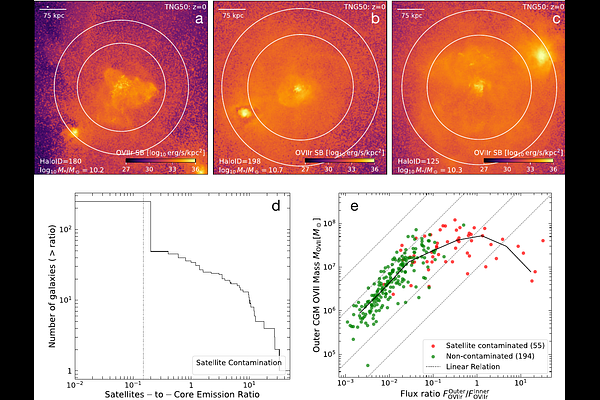
AbstractThe circumgalactic medium (CGM) regulates galaxy growth and retains the imprint of feedback from supernovae and supermassive black holes. However, the bulk of the hot CGM produces little X-ray emission and is challenging to study with X-ray telescopes. We propose a novel method for evaluating the CGM mass using resonant scattering of the helium-like oxygen (OVII) resonant line at $E=574$ eV. In a spherically symmetric and static CGM halo with a sharp central X-ray peak, the number of OVII ions within an outer radial shell can be calculated from the ratio of the two directly observable quantities: the OVII flux from the bright inner region and the scattered OVII flux from the shell (where the scattered flux can be much higher than the intrinsic emission). To evaluate the accuracy of this geometric estimate for realistic galaxies -- with satellites, asymmetries, and gas velocities -- we use a sample of galaxies from the TNG50 cosmological simulation. We find that, when the most irregular systems are excluded based on their X-ray observables, we accurately predict the OVII mass in the outer halo (e.g., in an $r=R_{\rm 500c}-R_{\rm 200c}$ shell) from the ratio of the fluxes in the corresponding annulus and the central peak region ($r<0.2R_{\rm 500c}$), with only a 10% bias and an rms scatter of $\sim 0.2$ dex. As OVII mass strongly correlates with the total oxygen and gas mass, this direct OVII-counting method enables indirect estimates of those quantities by future X-ray microcalorimeter missions, such as NewAthena and HUBS.