ABCG transporter knockouts alter integument and eye pigmentation with gene-specific effects on viability in butterflies and moths

ABCG transporter knockouts alter integument and eye pigmentation with gene-specific effects on viability in butterflies and moths
Shodja, D. N.; Yan, J.; Livraghi, L.; Yamada, A.; Martin, A.; Mazo-Vargas, A.
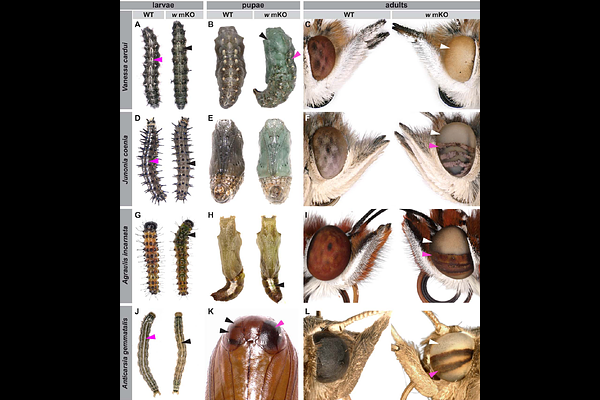
AbstractInsects possess remarkable diversity in pigmentation across life stages, generated from a limited number of pigment precursors. ABCG transporters play central roles in pigmentation by mediating the intracellular transport of these precursors, yet their functions outside a few model systems remain poorly characterized. Here, we investigate the roles of the ABCG transporter genes white (w), scarlet (st), and oily kinshiryu (ok) across five lepidopteran species representing both butterflies and moths. CRISPR-Cas9 knockouts reveal conserved, tissue-specific functions of ABCG transporters throughout development, affecting larval and pupal integuments as well as adult eyes, but not scale coloration. Notably, our data indicate that both ommochrome and uric acid deposition underlie the coloration and opacity of Lepidoptera larvae and pupae, with the relative contributions of these pathways differing across species and stages. We also reveal that the vivid orange coloration of Gulf fritillary caterpillars arises from the interplay of ommochromes and urate granules, providing a clear example of how these pathways combine to produce diverse integument pigmentation. Loss of white was deleterious in four species examined, whereas scarlet knockouts produced viable individuals with easily detectable pigmentation phenotypes, identifying scarlet mutant backgrounds as a practical genetic marker for functional studies. Together, these findings show that conserved ABCG transporter complexes are differentially deployed across tissues and life stages, providing a mechanistic basis for the evolutionary diversification of pigmentation in Lepidoptera and enabling expanded functional genomics and transgenesis in emerging model species.