An Unsupervised Search for Novel Instrumental Glitches in LIGO O4a: Multi-Scale Sensitization, Empirical Physical Vetoes, and Rate Upper Limits

An Unsupervised Search for Novel Instrumental Glitches in LIGO O4a: Multi-Scale Sensitization, Empirical Physical Vetoes, and Rate Upper Limits
Luca Cirfeta
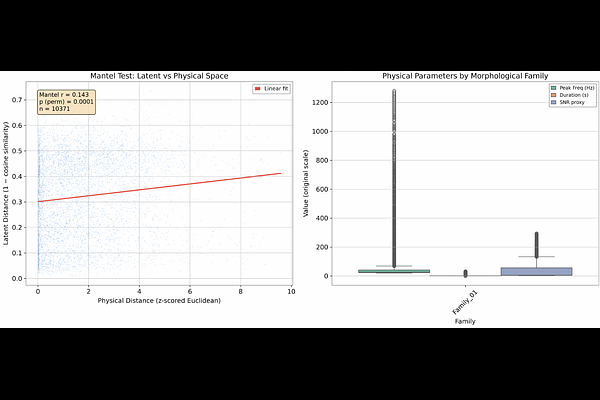
AbstractThe fourth observing run (O4) of Advanced LIGO, Virgo, and KAGRA presents unparalleled sensitivity, rendering unsupervised pipelines highly vulnerable to the non-stationary domain shift of the detectors' noise manifolds. We present DANTE V3, concluding a longitudinal investigation into unmodeled anomalies during early O4a. By expanding to a multi-scale geometric framework (0.5 s to 4.0 s), we amplify morphological sensitivity, extracting 10,372 unique candidates. To mitigate domain-shift artifacts, we introduce a block-bootstrap Domain Shift Defense (DSD) against a vector-quantized native background index. While 28.3% of candidates survive recalibration, global topological analysis reveals they lack discrete morphological cohesion. The survivors coalesce into a single macro-cluster without compact substructure; we show explicitly that morphological "diffusivity" comparisons used previously are confounded and retire them. Pristine background is even more monolithic (100% in one cluster vs 99.77% for survivors): this topology is a property of the embedding geometry, not of anomaly status. Executing a definitive physical environment monitoring (PEM) cross-correlation defense using an empirically calibrated null, one singleton is vetoed by a control-line coupling, while another survives as an uncatalogued instrumental outlier. Replacing the embedding-similarity cross-detector coincidence test with a physical normalized cross-correlation test, we find no coincident events among 8,749 candidates. We quote 90% frequentist Poisson upper limits on the rate of novel uncatalogued instrumental morphologies -- $R_{90} \le 5.83 \mathrm{yr}^{-1}$ (H1) and $R_{90} \le 5.63 \mathrm{yr}^{-1}$ (L1). This underscores the absolute necessity of native background recalibration and physical auxiliary vetoes in unsupervised gravitational-wave astronomy.