Seasonal patterns in Synechococcus pigment diversity at two temperate sites with contrasting oceanic regimes

Seasonal patterns in Synechococcus pigment diversity at two temperate sites with contrasting oceanic regimes
Dufour, L.; Faure, E.; Partensky, F.; Mattei, F.; Uitz, J.; Petit, F.; Vellucci, V.; Golbol, M.; Ratin, M.; Gouriou, B.; Gachenot, M.; Clairet, J.; Farrant, G. K.; Hoebeke, M.; Corre, E.; Antoine, D.; Baudoux, A.-C.; Bigeard, E.; Bureau, S.; Castel, J.; Chambouvet, A.; Couet, D.; Cre hriou, R.; de Vargas, C.; Dimier, C.; Le Gall, F.; Guillou, L.; Henry, N.; Rigaut-Jalabert, F.; Jeanthon, C.; Romac, S.; Simon, N.; Szymczak, J.; Trellu, C.; Walde, M.; Hickman, A.; Dutkiewicz, S.; Kehoe, D. M.; Not, F.; Thiebaut, E.; Garczarek, L.
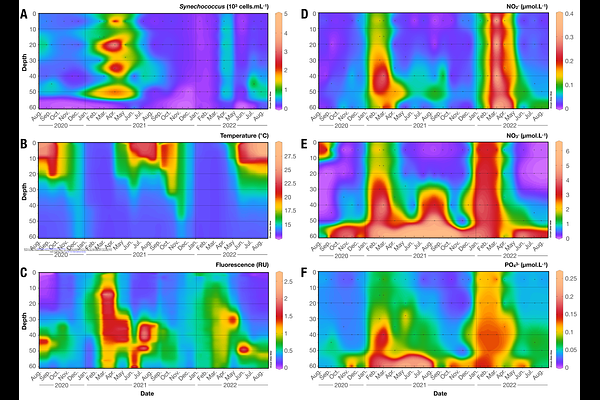
AbstractCompetition for light has driven extensive pigment diversification among phytoplankton species, yet how this diversity shapes their spatiotemporal distribution in the field has been little studied so far. The cyanobacterium Synechococcus is an ideal model for addressing this issue, since this group has colonized most light spectral niches in marine environments. Here, we used an approach based on marker read recruitment from metagenomes to analyze the seasonal succession of Synechococcus pigment types (PTs) at two time-series stations off French coasts exhibiting contrasting oceanic regimes. Marked seasonality was observed at both sites. The shallow, permanently mixed English Channel site SOMLIT-Astan was characterized by an alternation between green-light specialists (PT 3a) peaking in spring, and chromatic acclimaters type A (PT 3dA) accounting for most of the Synechococcus community in winter. In contrast, the pigment diversity was much higher at the deep Mediterranean station BOUSSOLE. In the upper layer, the two main PTs were the blue light specialists (PT 3c), which dominated the community in summer and fall, and PT 3dA cells, which were more abundant in spring. The third most abundant PT was chromatic acclimaters type B (PT 3dB), which accounted for up to 15% of the surface community in late fall. Strikingly, PT 3dA was dominant at depth during most of the year. Multivariate analyses between PT abundances, clade abundances and environmental factors, notably water color indexes, suggested new associations between PTs to specific clades and ecological niches. This study provides novel insights for refining distribution models of Synechococcus PTs and phytoplankton groups in general.