Engineering in vitro models of skeletal muscle with neuromuscular junctions using hierarchical micro-nano biomaterials: Cooperative effect of adhesion ligand nanoclustering and surface anisotropy

Engineering in vitro models of skeletal muscle with neuromuscular junctions using hierarchical micro-nano biomaterials: Cooperative effect of adhesion ligand nanoclustering and surface anisotropy
Nour, S.; Swiderski, K.; Salehi, S.; Lynch, G. S.; O'Connor, A. J.; Qiao, G. G.; Heath, D. E.
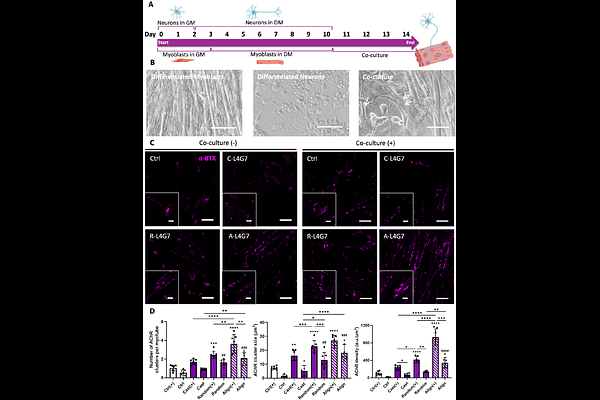
AbstractRobust development of in vitro mature skeletal muscle with functional neuromuscular junctions is an unmet challenge that must be addressed for advances in skeletal muscle tissue engineering and for the development of skeletal muscle tissue models for disease modelling and drug discovery. Herein, we developed hierarchical, anisotropic biomaterials that induced early maturation of more mature myotubes and the development of neuromuscular junctions (NMJs) during co-culture with motor neurons. We accomplished this by creating micro-nano biomaterial interfaces that presented nanoclusters of integrin-binding ligands to promote mechanotransduction on the surface of aligned electrospun microfibers. Controlling surface topography and nanoscale ligand clustering led to 1.5 to 2.5-fold increases in myoblast proliferation, myotube formation, elongation, and alignment; resulting in spontaneous twitching; and enhanced myotube-neuron connections, including increasing acetylcholine receptor clustering, neurite branching, and myotube contraction compared to control surfaces. These findings highlight the importance of tailoring adhesive peptide distribution and presentation for the in vitro development of NMJs and synaptic organization. This approach offers a valuable platform for fundamental research on muscle development and neuromuscular diseases, paving the way for improved skeletal muscle tissue engineering and drug screening strategies.