Discovery of a small peptide that activates both APCCdc20 and APCCdh1 in yeast, driving increased lifespan

Discovery of a small peptide that activates both APCCdc20 and APCCdh1 in yeast, driving increased lifespan
Harris, R. E.; Postnikoff, S. D.; Shukla, N. K.; Harkness, A. H.; Verdugo, C. Z.; Waddell, B. M.; Wu, C.-W.; Harkness, T. A.
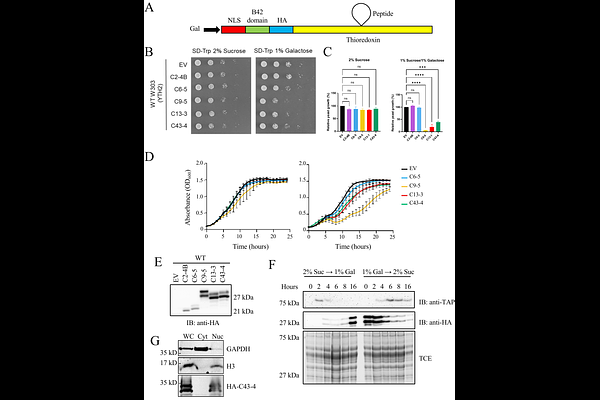
AbstractThe Anaphase Promoting Complex (APC) is a large evolutionarily conserved ubiquitin ligase that is controlled by the sequential co-activators, Cdc20 and Cdh1. The APC is required for cell cycle progression through mitosis and maintenance of G1/G0, with recent studies demonstrating the APC is importance for genome stability, longevity, and resistance to cancer progression. We hypothesized that the APC loses function in aging cells, thereby contributing to the aging program. Furthermore, we predicted that activation of the APC in aging cells will reverse the aging program, thereby extending lifespan. By introducing chronologically aging cells back into the cell cycle, we showed that the APC substrates Clb1 and Mps1 accumulated as cells aged, indicating that the APC lost activity in aging cells. We proposed that activation of APCCdh1 is critical for the health of nondividing cells, as CDH1 in human cells is required for tumor suppression and genome stability. Currently, an APCCdh1 activator does not exist. We previously used a 2-hybrid screen to discover small random peptides that could interact with APC subunits. Here, we randomly selected 7 peptides that interacted with Apc10, and one that interacted with Apc5, to test for effects on replicative lifespan (RLS; APCCdc20- and APCCdh1-dependent) and chronological lifespan (CLS; only APCCdh1-dependent). Many of the tested peptides could increase the RLS of the apc5CA mutant, but the increase in wild type RLS was peptide specific. We found that of the peptides tested for CLS, only the peptide referred to as C43-4 increased CLS in wild type cells, indicating that it was the only peptide to activate APCCdh1. We found that in chronologically aging cells expressing C43-4, Clb1 and Mps1 remained low, suggesting APC impairment in aging cells is reversible. The effects of C43-4 in chronologically aging cells was lasting and increased CLS even when added at late stages of aging. C43-4 action is translational, as C43-4 increased C. elegans lifespan in a daf-16- and aak-2-dependent manner. Our results describe the discovery of an evolutionarily conserved translational peptide that is the first described to specifically activate the anti-cancer and anti-aging APCCdh1 enzyme