Parabrachial CGRP Neurons Regulate Opioid Reinforcement

Parabrachial CGRP Neurons Regulate Opioid Reinforcement
Bystrom, L. L.; Margetts, A. V.; Kujas, N. M.; Bourgain-Guglielmetti, F. M.; Marinov, E. P.; Tuesta, L. M.
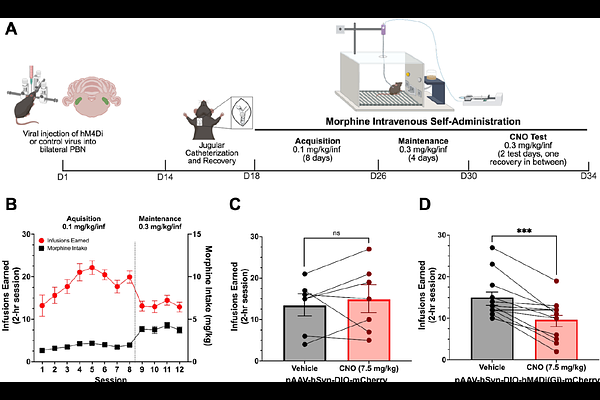
AbstractOpioid use disorder (OUD) is a chronic, relapsing disease driven by the reinforcing properties of opioids and perpetuated by avoidance of the negative affective states associated with the absence of the drug. Most available OUD treatments directly engage the mu-opioid receptor and may induce side effects that can compromise their therapeutic efficacy, thus underscoring the need for novel therapeutic alternatives. Calcitonin gene-related peptide (CGRP) is produced by a small population of neurons in the parabrachial nucleus (PBN) that has been shown to modulate itch, pain, as well as appetitive behaviors. Using a cell-specific nuclear labeling approach coupled with RNA-sequencing, we generated a baseline transcriptome of CGRPPBN neurons and confirmed expression of multiple genes associated with behavioral responses to appetitive stimuli, as well as enrichment of the mu-opioid receptor, suggesting that CGRPPBN neuron function may be sensitive to the presence of opioids. Indeed, cFos immunostaining showed that CGRPPBN neuron activity increases during early morphine abstinence and reduces gradually over 48 hours. Given the inhibitory effects of opioids on CGRPPBN neuron activity, we next tested whether these neurons could regulate opioid reinforcement. Using a mouse model of morphine intravenous self-administration, we found that chemogenetic inhibition of CGRPPBN neurons significantly reduced the number of morphine rewards earned in both single-dose and dose-response tests but did not affect context-induced morphine seeking after 21 days of abstinence. These results suggest that CGRPPBN neurons are sensitive to opioid administration and can regulate appetitive behaviors such as morphine-taking. Considering that CGRP signaling is regulated by opioid administration, molecular targets that regulate CGRP neurotransmission without direct mu-opioid receptor engagement may therefore serve as novel therapeutic avenues for the treatment of OUD.