Study of microbe-microbe interactions between the sexually transmitted parasite Trichomonas vaginalis with the cervicovaginal bacteria Lactobacillus iners

Study of microbe-microbe interactions between the sexually transmitted parasite Trichomonas vaginalis with the cervicovaginal bacteria Lactobacillus iners
Smedshammer, S.; Baxter, B.; Briceno, G. J.; Morales, K. E.; Lizcano, A.; Clark, T.; Willard, D.; Riestra, A. M.
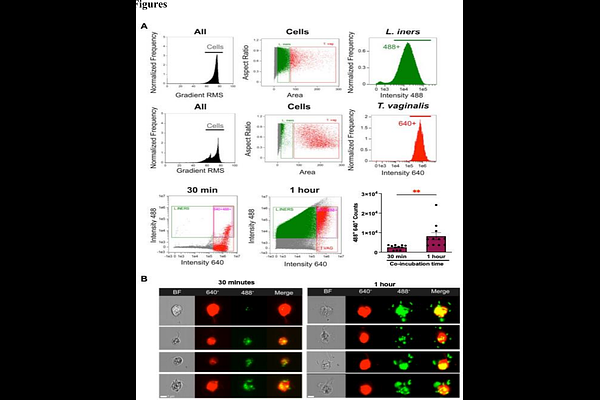
AbstractTrichomonas vaginalis is the leading cause of non-viral sexually transmitted infections and it is associated with comorbidities that affect female health. Lactobacillus iners is one of the most predominant bacteria in the cervicovaginal microbiome. As so, both microbes are likely to encounter one another upon T. vaginalis infection. To our knowledge, the interaction of both microbes has not been previously investigated. Here, we report that T. vaginalis and L. iners bind to one another at early time points of co-incubation. Using imaging flow cytometry and scanning electron microscopy, we capture the dynamics of this microbe-microbe association. We observed active remodeling of the T. vaginalis cell surface leading to thin-membrane protrusions that make contact with L. iners. Larger T. vaginalis membrane extensions that surround and engulf L. iners were also visible. These T. vaginalis-L. iners interactions ultimately lead to a reduction of L. iners viability while T. vaginalis viability was unaffected by exposure to L. iners. Inhibition of actin polymerization blocked T. vaginalis antibacterial activity against L. iners. Together our findings reveal novel insight about T. vaginalis-L. iners interactions and highlight a new T. vaginalis pathogenic effect.