Adaptive landscape of the metallo-β-lactamase NDM to emerging β-lactam-based therapies

Adaptive landscape of the metallo-β-lactamase NDM to emerging β-lactam-based therapies
Romero, F. D.; Drusin, S. I.; Bahr, G.; Gonzalez, G.; Bonomo, R. A.; Moreno, D. M.; Gonzalez, L. J.; Vila, A. J.
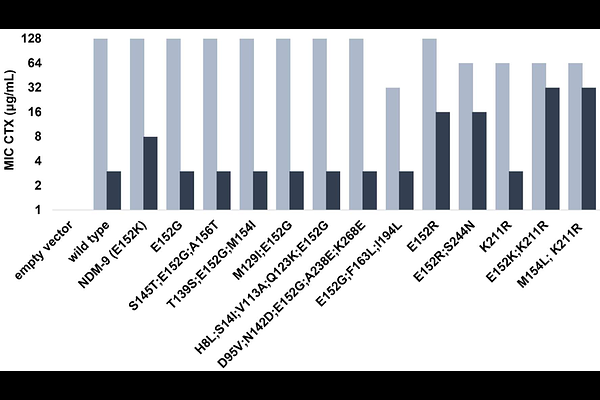
AbstractThe New Delhi metallo-{beta}-lactamase (NDM) is a major determinant of carbapenem resistance. This has prompted the development of novel therapeutic strategies to treat NDM producers. Since these therapies impose new selective pressures, their clinical deployment may favor NDM variants carrying escape mutations. To anticipate these events and inform future therapeutic decisions, we explored the evolutionary landscape of NDM-1 under different selective constraints. To this end, we generated a highly diverse library of blaNDM variants and challenged it with zinc starvation, antibiotics or {beta}-lactam/{beta}-lactamase inhibitor combinations that represent novel and emerging therapies. Selection under zinc limitation and cefotaxime identified mutational trajectories that recapitulate clinical NDM evolution, validating the diversity of the library and its predictive nature. Drug-specific selections revealed sharply different evolutionary pathways. Mecillinam selected a narrow evolutionary pathway centered on residues N220 and M67 which enhance productive active-site interactions with this penicillin. Cefepime/taniborbactam selected multiple escape routes, dominated by substitutions at E152 and, secondarily, K211, that impair productive interaction with taniborbactam. In contrast, cefiderocol/xeruborbactam and aztreonam/avibactam failed to select NDM variants conferring an improved resistance phenotype. These results show that NDM evolution is constrained by the chemistry of each therapeutic challenge. Substrate adaptation is possible for mecillinam, inhibitor escape is readily accessible for taniborbactam, whereas aztreonam- and xeruborbactam-based strategies impose high evolutionary barriers on NDM. Mapping drug-specific evolutionary landscapes can help anticipate resistance before clinical deployment and prioritize therapeutic strategies less likely to drive NDM-mediated escape.