Candidate Microlensing Brown Dwarfs in Binary Lens Systems from the 2023--2025 Observing Seasons

Candidate Microlensing Brown Dwarfs in Binary Lens Systems from the 2023--2025 Observing Seasons
Cheongho Han, Andrzej Udalski, Ian A. Bond, Chung-Uk Lee, Michael D. Albrow, Sun-Ju Chung, Andrew Gould, Youn Kil Jung, Kyu-Ha Hwang, Yoon-Hyun Ryu, Yossi Shvartzvald, In-Gu Shin, Jennifer C. Yee, Weicheng Zang, Hongjing Yang, Doeon Kim, Dong-Jin Kim, Seung-Lee Kim, Dong-Joo Lee, Sang-Mok Cha, Yongseok Lee, Byeong-Gon Park, Richard W. Pogge, Przemek Mróz, Michał K. Szymański, Jan Skowron, Radosław Poleski, Igor Soszyński, Paweł Pietrukowicz, Szymon Kozłowski, Krzysztof A. Rybicki, Patryk Iwanek, Krzysztof Ulaczyk, Marcin Wrona, Mariusz Gromadzki, Mateusz J. Mróz, Fumio Abe, David P. Bennett, Aparna Bhattacharya, Ryusei Hamada, Yuki Hirao, Asahi Idei, Stela Ishitani Silva, Shuma Makida, Shota Miyazaki, Yasushi Muraki, Tutumi Nagai, Togo Nagano, Seiya Nakayama, Mayu Nishio, Kansuke Nunota, Ryo Ogawa, Ryunosuke Oishi, Yui Okumoto, Greg Olmschenk, Clément Ranc, Nicholas J. Rattenbury, Yuki Satoh, Takahiro Sumi, Daisuke Suzuki, Takuto Tamaoki, Sean K. Terry, Paul J. Tristram, Aikaterini Vandorou, Hibiki Yama
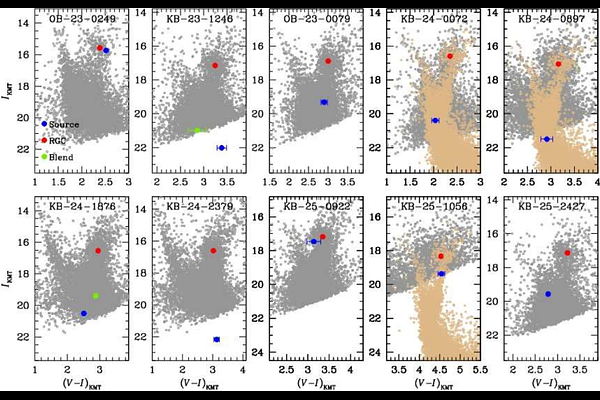
AbstractWe present detailed light-curve analyses of ten binary-lens microlensing events observed during the 2023--2025 seasons and selected as candidates for hosting brown-dwarf companions. The sample includes OGLE-2023-BLG-0249, KMT-2023-BLG-1246, OGLE-2023-BLG-0079, KMT-2024-BLG-0072, KMT-2024-BLG-0897, KMT-2024-BLG-1876, KMT-2024-BLG-2379, KMT-2025-BLG-0922, KMT-2025-BLG-1056, and KMT-2025-BLG-2427. For each event, we carry out modeling of the light curve, explore relevant degeneracies, and, when finite-source effects are present, determine the angular Einstein radius. For OGLE-2023-BLG-0249, we additionally measure the microlens parallax, which allows a direct determination of the lens masses and distance. For the remaining events, we estimate the physical lens properties via Bayesian analyses incorporating Galactic priors. The resulting posteriors show that the lens companions in all systems have median masses in the brown-dwarf regime, and the lenses of two events (KMT-2025-BLG-0922 and KMT-2025-BLG-1056) are consistent with binaries in which both lens components fall within the brown-dwarf mass range. Spanning a wide range of projected separations and distances, these detections illustrate the power of high-cadence microlensing surveys to build a census of brown-dwarf companions, including faint and distant systems beyond the reach of flux-limited methods.