Constraints on the Crystallinity of Water Ice in Planet-forming Disks from Infrared Scattered-Light Spectra

Constraints on the Crystallinity of Water Ice in Planet-forming Disks from Infrared Scattered-Light Spectra
Kanon Nakazawa, Ryo Tazaki
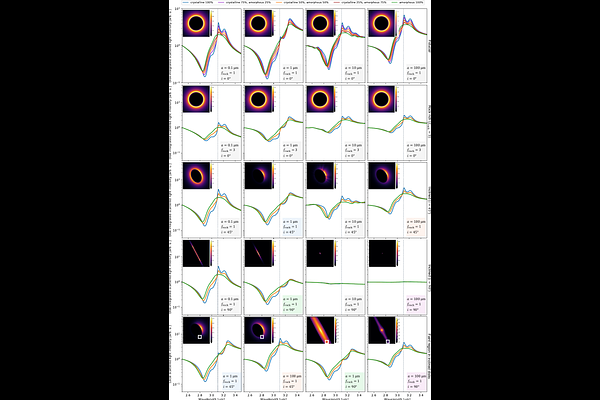
AbstractThe crystallinity of water ice not only records the thermal history experienced by an astronomical body, but also affects the composition of forming planets by controlling the trapping of volatile materials in amorphous ice and their subsequent transport. An additional structure within the 3~$\rm μm$ water-ice absorption band, known as the Fresnel feature, may serve as a diagnostic of ice crystallinity. Recent observations with the James Webb Space Telescope have detected a Fresnel peak in a debris disk and in Trans-Neptunian Objects (TNOs). Here, we propose a portable expression that translates the observed Fresnel peak strength into the degree of crystallinity of icy grains in debris disks. Our formula targets scattered light at around 90$^{\circ}$ angles, which are easily accessible for spatially resolved debris disks regardless of the inclination angle. Applying this expression, we derive the degree of crystallinity of a debris disk around HD 181327 to be 10-20%. We also study the Fresnel feature in protoplanetary disks and find that it is generally weaker than in debris disks even for the same crystallinity. We then analyzed a scattered light spectrum of the protoplanetary disk around d216-0939, which shows a weak crystalline feature, and inferred a crystallinity of $\sim$50%. We conclude that the Fresnel feature is a reliable observational tracer for ice crystallinity, and future near-IR spectroscopic observations will be crucial to elucidate the crystalline ice evolution.