Multiple shocks generated by the 2024 May 14 coronal mass ejection

Multiple shocks generated by the 2024 May 14 coronal mass ejection
Mohamed Nedal, Catherine Cuddy, David M. Long, Shilpi Bhunia, Pietro Zucca, Peter T. Gallagher
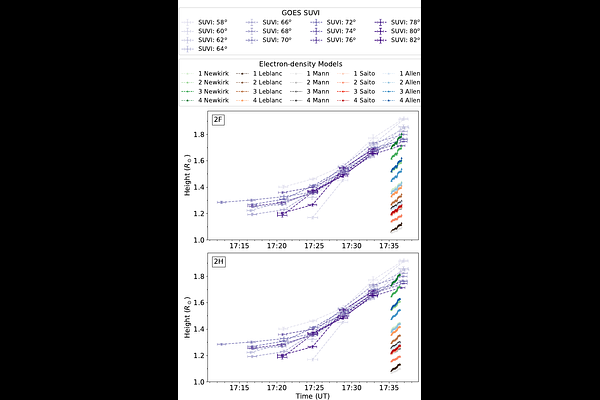
AbstractThis study characterises a series of type~II radio bursts associated with a CME that occurred on 14 May, focusing on the coronal conditions during the event and identifying the likely location of the shocks where the radio bursts are generated. The CME was tracked using a combination of white light and extreme ultraviolet observations of the solar corona taken by three instruments: GOES-SUVI, two coronagraphs of the SOHO-LASCO, together with ground-based radio observations between 10-240~MHz from I-LOFAR. The radial distances of the radio sources were examined using a series of density models, with both PFSS and MHD models used to examine the coronal plasma conditions. Four type~II bursts were identified in the I$-$LOFAR radio dynamic spectrum over $\sim$15~minutes, exhibiting features such as band splitting, herringbones, and fragmentation. The shocks were found to have speeds ranging between $\sim$443$-$2075~km s$^{-1}$, with drift rates of $\sim-$361 to -78~kHz~s$^{-1}$. The shocks were found to have a $M_A \approx$ 3.21$-$3.57. indicating that they were super-Alfvénic. The first type~II burst was triggered $\sim$18~minutes after the CME launch, with each burst appearing to have been generated at a different height in the corona. Analysis of the derived kinematics and modelling results suggests that the type~II bursts were likely produced at the shoulders of the CME near the flanks, where open magnetic field lines and relatively low Alfvén speeds facilitated shock formation. This multi-instrument study shows that multiple type II bursts from a single CME originated at different coronal heights, with modelling indicating their generation near the CME flanks, where low Alfvén speeds and open magnetic field lines facilitated shock formation.