SaNDi-SHoP: Searching for Satellites'N'Disks with a Star-Hopping Program I. Analysis of the close surroundings of DI companions

SaNDi-SHoP: Searching for Satellites'N'Disks with a Star-Hopping Program I. Analysis of the close surroundings of DI companions
Cecilia Lazzoni, Alice Zurlo, Silvano Desidera, Andrea Bernardi, Sebastian Pérez, Dino Mesa, Domenico Barbato, Pedro Henrique Nogueira, Anuroop Dasgupta
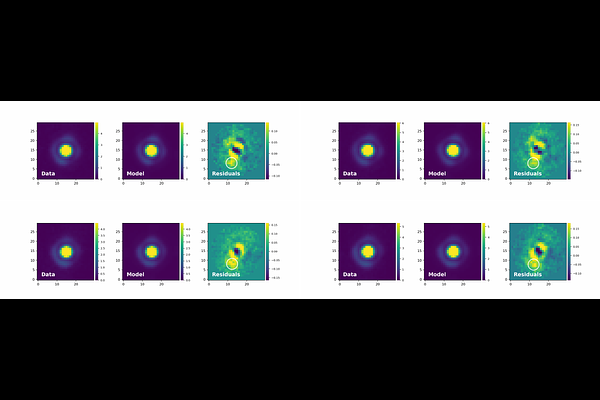
AbstractWe aim to search for satellites and circumplanetary or circumsubstellar disks around directly imaged substellar companions, exploring their immediate environment to constrain the conditions for satellites and disk formation. We conducted a dedicated survey of twelve planets and brown dwarfs with VLT/SPHERE using a novel application of the star hopping technique. By building libraries of contemporaneous point spread function (PSF) references from nearby stars, we applied a frame-by-frame subtraction of each companion's flux using the Negative Fake Companion method (NEGFC). This approach mitigates temporal PSF variability and enhances sensitivity to faint circumplanetary features. We derived contrast curves, translated them into mass detection limits using evolutionary models, and constrained the dynamically stable regions through estimates of Hill radii from orbital fits. Our analysis yields stringent limits on the presence of massive satellites, generally excluding companions more massive than a few Jupiter masses at separations beyond 1-5 au, depending on each system's Hill radius. In most cases, no convincing point-like or extended residuals were found. However, we identify promising signals for three systems: extended residuals consistent with a circumplanetary disk around CT Cha b, tentative repeated residuals near TYC 8047-232-1 B that may trace a bound satellite companion of 3-6 MJup, and marginal residual signals at the location of the previously reported candidate around DH Tau b, whose interpretation, however, remains uncertain due to possible contamination by instrumental effects. These results confirm the power of star hopping in reducing PSF-related artifacts and provide some of the most stringent constraints to date on the mass and location of potential satellites and disks around directly imaged substellar companions.