Detection of a weak magnetic field in the Balmer emission line white dwarf WDJ1653-1001

Detection of a weak magnetic field in the Balmer emission line white dwarf WDJ1653-1001
Abbigail Elms, Stefano Bagnulo, Pier-Emmanuel Tremblay, Tim Cunningham, James Munday, John Landstreet, Kareem El-Badry, Ilaria Caiazzo, Carl Melis, Viktoria Pinter, Alycia Weinberger
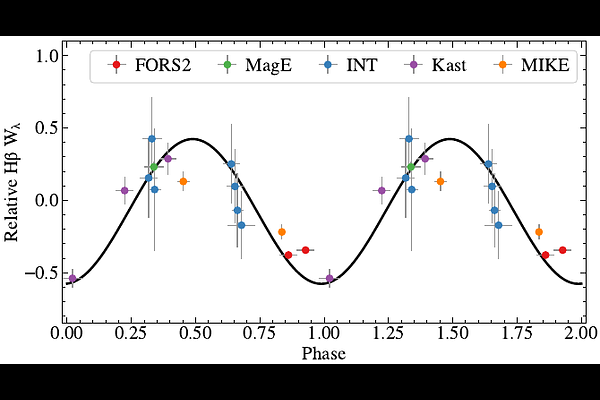
AbstractThe small DAHe and DAe spectral classes comprise isolated, hydrogen-dominated atmosphere white dwarfs that exhibit variable photometric flux and Balmer line emission. These mysterious systems offer unique insight into the complex interplay between magnetic fields, stellar rotation and atmospheric activity in single white dwarfs. DAHe stars have detectable magnetic fields through Zeeman-split spectral lines, whereas DAe stars lack such splitting. We report the first discovery and characterisation of magnetism in the DAe white dwarf WDJ165335.21-100116.33 with new time-resolved spectropolarimetry from FORS2. We detect a weak but variable longitudinal magnetic field with values $\langle B_z \rangle > -9.2 \pm 2.4$ kG and $\langle B_z \rangle < -2.2 \pm 1.0$ kG. Independent ZTF and ATLAS photometry reveal a consistent period of P = 80.3070 $\pm$ 0.0007 h. Time-resolved optical spectroscopy obtained with six ground-based instruments demonstrates strong modulation in the strength of the H$α$ and H$β$ Balmer line emission with P = 80.2922 $\pm$ 0.0108 h. The photometric flux and Balmer emission strength vary in antiphase, with the strongest magnetic detections coinciding with phases of low photometric flux and strong line emission. These characteristics support the theory that a magnetically active, temperature-inverted spot/region is producing an optically thin chromospheric emission region. Comparison with other DAe and DAHe white dwarfs reveals all systems have a strikingly similar antiphase phenomenology, reinforcing the theory that they are subject to a unified physical mechanism. With the detection of a weak magnetic field, we reclassify WDJ165335.21-100116.33 as a low-field DAHe white dwarf.