Spinal rotational dynamics orchestrate locomotor recovery

Spinal rotational dynamics orchestrate locomotor recovery
Colard, J.; Harnie, J.; Berg, R. W.; Frigon, A.
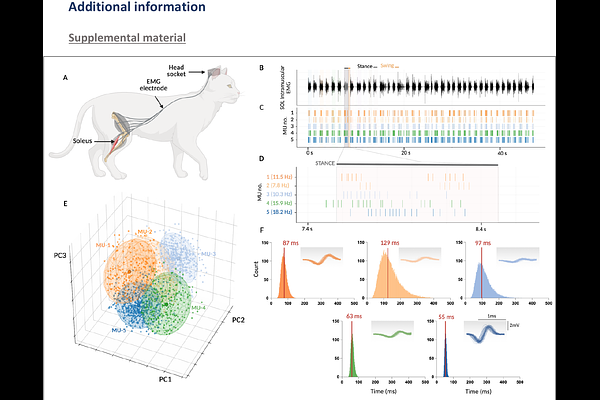
AbstractLocomotion is one of the most fundamental functions of the nervous system, yet the principles that generate it and how it might be restored after spinal cord injury remain unresolved. Walking is possible even after complete spinal cord injury and a traditional assumption is that this activity emerges from modular flexor-extensor transitions driven by somatosensory feedback. To test this assumption, we recorded bilateral motor unit activity from sixteen flexor/extensor hindlimb muscles in awake cats walking on a treadmill. We found that spinal motor populations operate according to a fundamentally different principle. Rather than alternating between flexion and extension, population activity continuously rotated through all phases of the locomotor cycle within a low-dimensional neural manifold. Remarkably, this rotational organization persisted after complete spinal cord injury, revealing the preservation of a cyclic attractor despite substantial alterations in motor outputs. Computational modeling further indicated that locomotor activity was more consistent with an autonomous regime than with somatosensory-driven control. These findings suggest that locomotor recovery after complete spinal cord injury reflects the preservation of an intrinsic spinal attractor and that somatosensory feedback contributes to, rather than generates, the locomotor rhythm. More broadly, they establish rotational population dynamics as a fundamental organizing principle of spinal locomotor control and recovery.