Classical Hardware Acceleration of Quantum Autoencoders for Real-Time Anomaly Detection in Collider Experiments

Classical Hardware Acceleration of Quantum Autoencoders for Real-Time Anomaly Detection in Collider Experiments
Ivan Ge, Sagar Addepalli, Abhilasha Dave, Julia Gonski
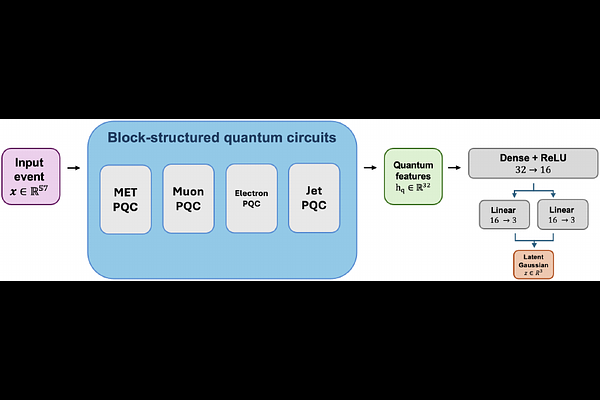
AbstractQuantum machine learning (QML) algorithms in high energy physics (HEP) can efficiently represent and leverage long-range, high-order correlations in high-dimensional collider data, potentially with fewer parameters and favorable scaling relative to classical models. Deployment of QML in real-time collider applications such as trigger systems requires the ability to emulate and compile quantum circuits classically, then synthesize the resulting quantum gates onto low-latency hardware accelerators, namely field-programmable gate arrays (FPGAs). We present a study of variational quantum autoencoder models for real-time anomaly detection triggers in modern collider experiments. The models achieve performance comparable to state-of-the-art classical approaches and, after FPGA synthesis, satisfy resource usage and timing constraints consistent with trigger applications in future colliders. This work provides one of the first FPGA implementations of QML models for HEP triggers, enabling higher-capability models in today's classical data acquisition pipelines while advancing quantum readiness of collider experiment infrastructure.