Efficient Exoplanet Imaging Simulations of the Habitable Worlds Observatory

Efficient Exoplanet Imaging Simulations of the Habitable Worlds Observatory
Jamila Taaki, Farzad Kamalabadi, Athol Kemball, Lia Corrales, Alfred O. Hero
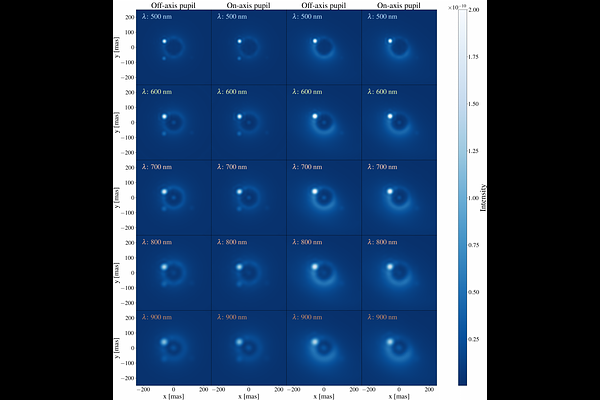
AbstractDirect imaging simulations of starshades and other proposed mission concepts are needed to characterize planet detection performance and inform mission design trades. In order to assess the complementary role of a 60 m starshade for the Habitable Worlds Observatory (HWO), we develop the optical model of a starshade and simulate solar system imaging at 0 degrees and 60 degrees inclinations. The optical core throughput of a direct-imaging system is a key metric that governs exposure time and the potential exoplanetary yield of a mission. We use our optical model to evaluate core throughput, incorporating 6 m segmented and obscured telescope apertures, over the visible to near-infrared wavelength band (500-1000 nm). Accurate diffractive optical simulations of this form require many large Fourier transforms, with prohibitive run-times, as both the starshade mask and telescope aperture require fine-scale spatial sampling. We introduce a Fourier sampling technique, the Bluestein Fast Fourier Transform (BFFT), to efficiently simulate diffractive optics and enable high-fidelity simulations of core throughput. By characterizing sampling requirements and comparing BFFT's computational complexity to standard Fourier methods (for example, DFT and FFT), we demonstrate its efficiency in our optical pipeline. These methods are implemented in PyStarshade (Taaki 2025), an open-source Python package offering flexible diffraction tools and imaging simulations for starshades. Our results show the HWO starshade used with a segmented off-axis telescope aperture achieves an optimal core throughput measured within a photometric aperture of radius 0.7 lambda/D of 68 percent. With an additionally obscured aperture, a 66 percent core throughput is achieved.