Dynamically cold discs in high-redshift galaxies: comparison between ALMA observations and TNG50

Dynamically cold discs in high-redshift galaxies: comparison between ALMA observations and TNG50
Yi He, Qi Guo, Filippo Fraternali, Hang Yang, Shihong Liao
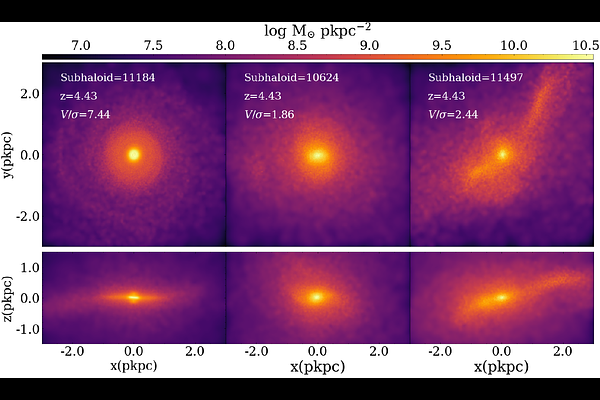
AbstractObservations of highly rotationally supported gas discs in high redshift ($z$ > 3) star-forming galaxies challenge our understanding of galaxy formation, as the prevailing view holds that galaxies in the early universe are dynamically hot due to frequent mergers, gas accretion, and strong stellar feedback. We examined the kinematic properties of massive ($M_{\star} \geq 10^{10}\,M_{\odot}$) star-forming galaxies in the TNG50 cosmological hydrodynamical simulation in the redshift range $3\leq z \leq 5$. Mock emission line datacubes were constructed and analysed using the same methodology as for [CII] observations with ALMA. We measured the ratio of the gas rotation velocity ($V$) to velocity dispersion ($σ$) finding that most galaxies have $V/σ\sim$ $2-3$, lower than observed. However, a few simulated galaxies show $V/σ$ > 5. Such "cold" discs, selected at $z=4$, remain dynamically colder than most of the TNG population across $z=3-5$. A galaxy with $V/σ\gtrsim10$ appears in a transient phase that lasts $\leq200$ Myr. Dynamically cold disc formation in TNG50 is promoted by gas accretion with angular momentum aligned with the pre-existing disc, while most galaxies undergo misaligned accretion. Dynamically cold discs also show lower mass accretion rates and better aligned stellar and dark-matter angular momentum vectors. By tracing their evolution to $z = 0$, we find that one-third become massive disc galaxies and two-thirds become ETGs.