MPNN-guided redesign of PET hydrolases with enhanced catalytic activity below the PET glass transition temperature

MPNN-guided redesign of PET hydrolases with enhanced catalytic activity below the PET glass transition temperature
Grinen, A.; Eltit, V.; Duran-Osorio, F.; Aviles, J.; Zacconi, F. C.; Carcamo Noriega, E.; Bahl, C. D.; Meinen, B. A.; Ramirez-Sarmiento, C. A.
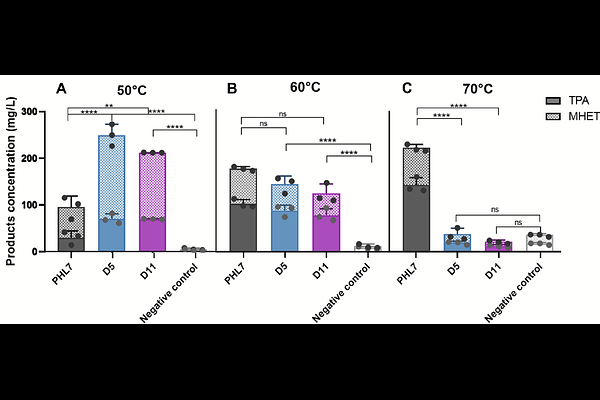
AbstractThe enzymatic depolymerization of polyethylene terephthalate (PET) presents a sustainable route for plastic circularity, but its industrial viability is disadvantaged by the need for thermostable enzymes that remain active under mild, energy-efficient conditions. While the Polyester Hydrolase Leipzig 7 (PHL7) rapidly degrades amorphous PET near its melting point, its poor protein expression, inactivation issues at temperatures above 60{degrees}C and slow depolymerization activity below 60{degrees}C limit its practical application. Here, we employ inverse folding models ProteinMPNN and LigandMPNN, informed by structural and evolutionary information, to redesign the sequence of PHL7, aiming to improve protein expression, thermal stability and activity. From 36 designed variants, we identified two (termed D5 and D11) with significantly enhanced PET depolymerization rates at lower temperatures, where enzymatic performance is typically limited. Remarkably, design D5 at 50{degrees}C achieved the same product yield as PHL7 at 70{degrees}C in 24 h PET microparticle degradation assays, with a shifted product profile favoring mono-(2-hydroxyethyl) terephthalate (MHET) over terephthalic acid (TPA). Molecular dynamics simulations revealed that the active redesigns exhibit enhanced local flexibility in key active site regions at 50{degrees}C, providing a mechanistic understanding of their low-temperature catalysis. This work demonstrates that computational sequence redesign can optimize biocatalysts for lower production costs and milder operational conditions. Furthermore, the D5 variant enables a potential route to resynthesize virgin PET via MHET polycondensation, offering an efficient circular economy pathway.