Temperature stress resilience in polar Chlamydomonas is regulated by acclimation to light and salinity: implications for survival in a changing world

Temperature stress resilience in polar Chlamydomonas is regulated by acclimation to light and salinity: implications for survival in a changing world
Osmers, P.; Szenasi, A.; Kostyniuk, L.; Caputo, S.; Bradette, N.; Cvetkovska, M.
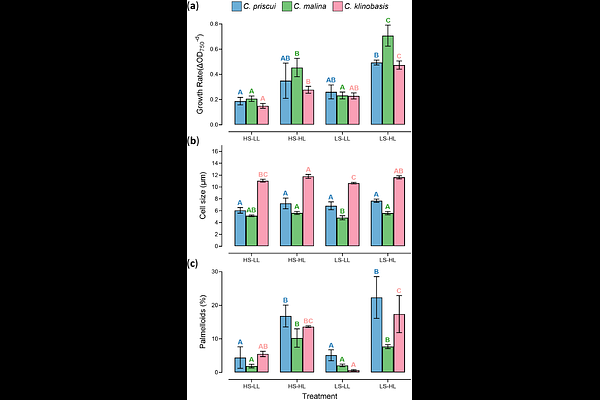
AbstractAquatic algae are key primary producers in the Arctic and Antarctic, yet how cold-water species respond to environmental change is poorly understood. The Polar Regions are increasingly exposed to frequent heat waves, leading to declining ice cover, increased light availability, and decreasing salinity in polar waters. We compared three phylogenetically related but geographically distant polar Chlamydomonas species to test how habitat history shapes algal responses to light, salinity, and temperature stress. We assessed the growth, morphology, and photochemistry of psychrophilic Chlamydomonas acclimated to native-like (lower light, higher salinity) and climate-shifted conditions (higher light, lower salinity). Next, we exposed acclimated cultures to a lethal heat shock and observed how acclimation affects algal temperature stress resilience. All three species acclimated to climate-shifted conditions grew rapidly but showed the greatest sensitivity to temperature stress, with rapid loss of viability and photosynthetic efficiency. In contrast, slow-growing cultures acclimated to native-like conditions exhibited significantly greater resilience to temperature stress. Our work is the first to directly link light and salinity acclimation with temperature resilience in psychrophilic algae, suggesting that fast-growing polar green algae may be particularly vulnerable to increasingly frequent heat waves, with major implications for primary productivity in polar environments.