Scalable 3D cell-interaction analysis via supercell graphs for prostate cancer risk stratification

Scalable 3D cell-interaction analysis via supercell graphs for prostate cancer risk stratification
Zhao, Y.; Chow, S. S. L.; Yan, R.; Brenes, D.; Serafin, R.; Almagro-Perez, C.; Song, A. H.; Lal, P.; Chan, E.; Downes, M.; Baraznenok, E.; Lopez, J. S.; Madabhush, A.; Mahmood, F.; True, L. D.; Liu, J. T. C.
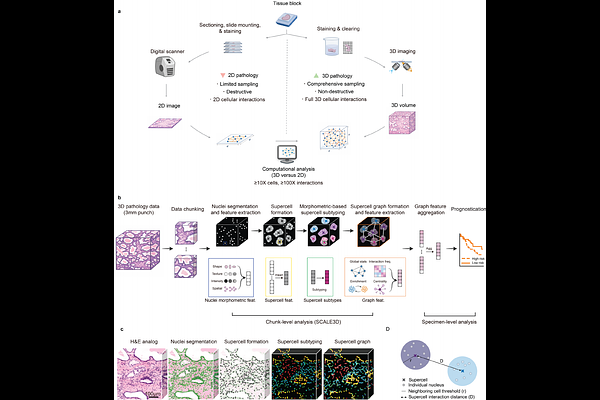
AbstractCellular interactions underlie fundamental biological processes but are not fully represented in conventional 2D histology images. While 3D pathology allows for more-accurate construction of cell-level graphs, machine-learning models are computationally unwieldy and prone to overfitting, especially when dealing with small cohorts. Here, we introduce SCALE3D, a SuperCell graph Analysis framework for LargE 3D pathology datasets. In SCALE3D, spatially adjacent and morphologically similar cells are grouped into functional supercells. Supercell subtypes are defined via morphology-based clustering and 3D graphs connecting these supercells are used to model their interactions. Validation was performed with 76 radical prostatectomy specimens from patients with known 5-year biochemical recurrence (BCR) outcomes. SCALE3D-derived features achieve higher performance for BCR prediction than established 3D nuclear and glandular morphological features. Combining these complementary features further improves prediction performance. Compared to individual cell-level 3D graphs, SCALE3D maintains comparable prognostic performance with improved noise tolerance while reducing computational times by up to 1,000-fold.