Capturing statistical isotropy violation with rotational averages

Capturing statistical isotropy violation with rotational averages
Vaishali R, Dipayan Mukherjee, Tarun Souradeep
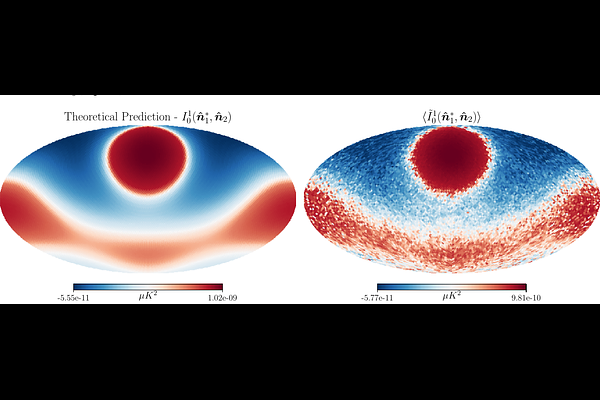
AbstractRecent high precision cosmological observations have revealed several anomalies in the Cosmic Microwave Background (CMB), indicating possible violations of statistical isotropy (nSI). Typically, nSI in the CMB sky is studied in the harmonic space, such as, using the Bipolar Spherical Harmonics (BipoSH) formalism, where the BipoSH coefficients capture the general structure of the angular correlation function. In this work, we present a geometric real space framework to quantify violations of statistical isotropy complementing the BipoSH approach. This geometric approach involves averaging the angular correlation function over all rotated configurations, weighted by Wigner matrices. These rotational averages systematically isolate the nSI components of the CMB sky. They also provide a physical space based route to interpretation of how the BipoSH formalism captures breaking of rotational symmetry. As a demonstration, we consider an analytical dipole modulation model. We numerically implement the rotational average measures and show their agreement with their harmonic space counterparts. The real space approach to quantify nSI could be advantageous in certain scenarios: rotational averages can directly extract nSI information from the correlation function at the level of a given multipole, bypassing the need to compute BipoSH coefficients up to arbitrarily high internal ranks. Importantly, analyzing the temperature map in real space can circumvent the unavoidable partial-sky effects present in CMB observations, which typically complicate harmonic space approaches. We envisage broader applications of this formalism to studies of primordial non-Gaussianity, CMB polarization, and weak gravitational lensing, as well as to the characterization of general random fields on a sphere.