Disentangling the dark and stellar mass through precise lens modelling of the JWST observation of lensed quasar WFI2033--4723

Disentangling the dark and stellar mass through precise lens modelling of the JWST observation of lensed quasar WFI2033--4723
Tian Li, Thomas E. Collett, Coleman M. Krawczyk, Wolfgang J. R. Enzi, Aymeric Galan
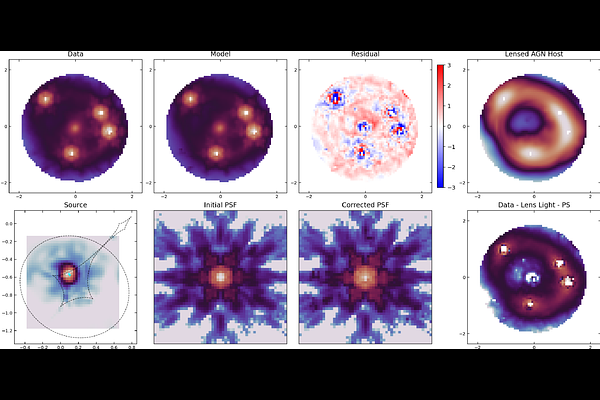
AbstractWe use high-resolution JWST/NIRCam imaging and measured time delays to model the quadruply imaged quasar WFI2033--4723 with a composite stellar plus dark-matter mass model. We first construct an elliptical power-law baseline model and recover Fermat-potential differences (fpd) consistent with previous HST-based and JWST-based analyses, providing a reference scale for composite modelling. We then replace the total mass profile with a physically motivated decomposition in which the stellar mass follows a multi-Gaussian expansion of the lens light, with a free radial mass-to-light gradient, and the dark matter is described by a generalized Navarro--Frenk--White (gNFW) halo. Using two external cosmological priors, Planck+DESI and Pantheon+SH0ES, the measured time delays constrain the mass-sheet-transformation freedom that would otherwise damage the stellar--dark-matter decomposition. In both cosmological cases, the stellar normalization lies between the expectations for Chabrier and Salpeter initial mass functions, while the radial mass-to-light gradient is not strongly required by the data (mildly positive). The dark matter halo has an inner slope $γ_{\rm in}\simeq1.3$, steeper than a standard NFW cusp, and the main astrophysical conclusions are insensitive to the adopted cosmological prior. This work shows that composite time-delay lens modelling can effectively separate baryons from dark matter. As a qualitative check, we reverse the logic and use our composite lens model without kinematic information to infer the cosmology instead. However, the strong degeneracy between $H_0$ and the halo scale radius $R_s$ prevents a robust standalone constraint.