From Origins to Observables: Distinguishing Dark Compact Objects with Population-Level Microlensing Signatures

From Origins to Observables: Distinguishing Dark Compact Objects with Population-Level Microlensing Signatures
Joel Cortez Osuna, Sarah Shandera
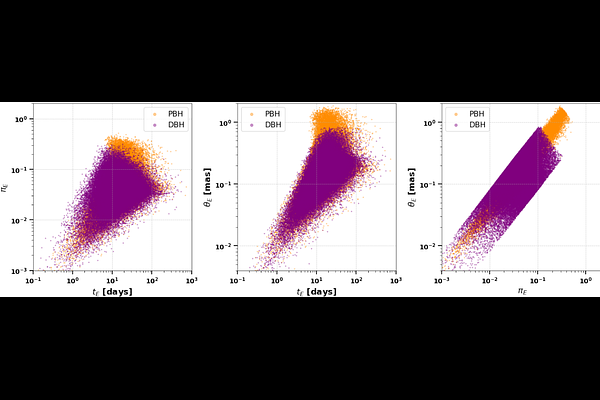
AbstractWhile primordial black holes (PBHs) have long been a benchmark target for microlensing searches, the modern landscape of dark matter models suggests other, distinct, formation channels for compact objects made of dark matter. In the large class of self-interacting, dissipative models, dark matter has cooling channels that can enable fragmentation and gravitational collapse of some dark matter into compact objects, including black holes. The resulting populations have mass distributions, bias parameters, and abundance, spatial profile and velocity dispersion within the Milky Way that all differ from those of PBHs. We demonstrate that these population-level differences can leave imprints in the space of microlensing observables, with the differences in how the populations trace the dark matter giving the primary distinguishing lever. We discuss the possible overlap of microlensing signals from dark and baryonic lenses, and the complementarity of microlensing detection or constraints with other gravitational probes of novel populations of dark matter origin.