Combining spectroscopy and wavefront control at deep contrast with photonic lanterns

Combining spectroscopy and wavefront control at deep contrast with photonic lanterns
Mona El Morsy, Olivier Guyon, Barnaby Norris, Sergio Leon-Saval, Sebastien Vievard, Julien Lozi, Thayne Currie, Yoo Jung Kim, Michael Fitzgerald, Nemanja Jovanovic
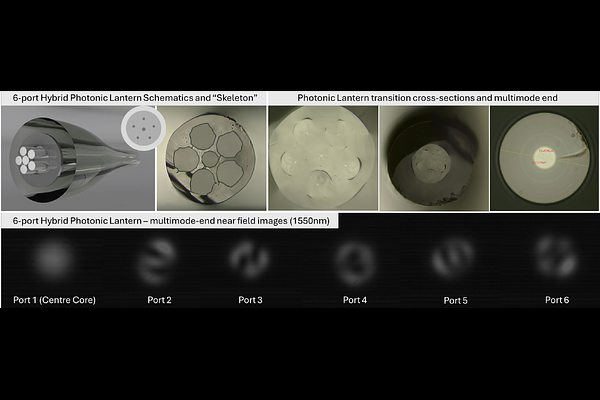
AbstractHWO aims to directly image objects orbiting Sun-like stars, using a 6-m telescope capable of high-contrast imaging ($10^{-10}$) and spectroscopy to search for biosignatures in planets located in the habitable zone. Recent laboratory demonstrations and ground-based telescope projects have shown the effectiveness of SMFs in spectroscopy, paving the way for SMF-fed spectrographs in future space missions like HWO. SMFs enhance spectral stability and reduce modal noise. HWO spectroscopy will need extended integration times, potentially lasting weeks. During these observations, the wavefront must be precisely measured and maintained to achieve the deep contrast and robust calibration of starlight contamination necessary for exoplanet characterization. We show that photonic lanterns (PLs) are ideally suited to meet these requirements. PLs are compact devices that couple light over a broader angular range than SMFs, ensuring higher throughput, converting a multimode input into multiple single-mode outputs. Positioned at the focal plane, they measure the complex amplitude of the coherent starlight within $\sim$ 2 l/D of the planet image, acting as compact wavefront sensors. Among the different variants of PLs that have emerged, the Hybrid-Mode Selective Photonic Lantern (HMSPL) is particularly attractive, as it directs object light into a central SMF feeding a mid-R spectrograph for exoplanet spectroscopy, while the adjacent SMFs route surrounding speckle light to a low-R spectrograph for rapid wavefront sensing. This dual function eliminates non-common path aberrations, optimizing injection efficiency and background suppression. We introduce HMSPL's dual role and planned tests at UTSA's high-contrast imaging lab and at SCExAO at the Subaru Telescope.