A quantitative approach to species occupancy across communities: the co-occurrence-occupancy curve

A quantitative approach to species occupancy across communities: the co-occurrence-occupancy curve
Ontiveros, V. J.; Mariani, S.; Megias, A.; Aguirre, L.; Capitan, J. A.; Alonso, D.
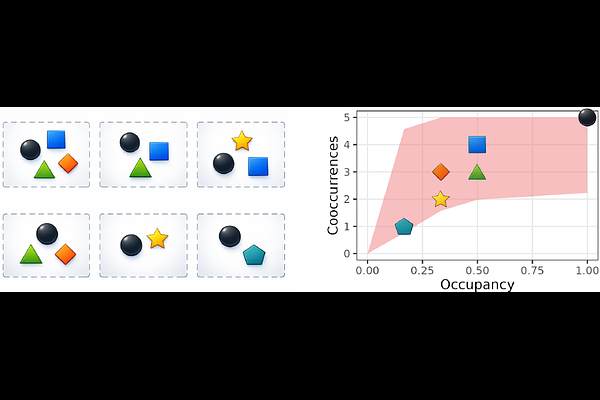
AbstractSpecies tolerating the same environmental conditions can potentially colonize and thrive in the same habitats and eco-regions. Are any pair of those species equally probable to co-occur in the same community? Can we quantify the propensity of two species to co-occur together? Here, we focus on a simple but largely overlooked community-level pattern: the co-occurrence-occupancy curve, which relates the tendency of species to co-occur with others to their total occupancy across sites. We first define this empirical curve and then derive its expected shape under a random null model that assumes site equivalence and species independence. Building on these results, we introduce the Species Association Index (SAI), an occupancy-standardized measure that quantifies the tendency of a species to associate with others independently of its overall frequency of occurrence. The SAI enables meaningful comparisons among species with contrasting occupancies and provides a transparent benchmark against which departures from neutrality can be assessed. We illustrate the approach using two contrasting systems -tropical rain forest trees on Barro Colorado Island and organisms from Mediterranean rocky shores- highlighting both the generality of the co-occurrence-occupancy framework and its limitations.