Thermal evolution of Uranus and Neptune, hydrogen-water phase separation and the role of methane

Thermal evolution of Uranus and Neptune, hydrogen-water phase separation and the role of methane
Marina Cano Amoros, Nicola Tosi, Nadine Nettelmann
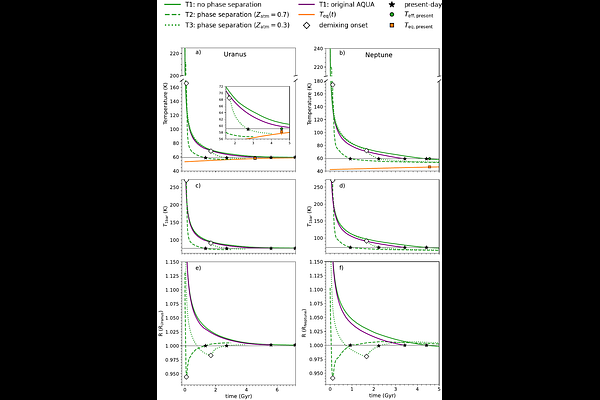
AbstractAdiabatic evolution models of Uranus and Neptune with constant compositional stratification miss their observed luminosities: Uranus is fainter than commonly predicted, while improved equations of state (EoS) have recently led to a brightness problem for Neptune. In adiabatic models of Jupiter and Saturn, helium rain is thought to enhance luminosity. In the ice giants, hydrogen-water phase separation (H2-H2O demixing) with water rain has recently been predicted. We aim to understand how H2-H2O demixing and the EoS of water influence the luminosity of Uranus and Neptune. We use state-of-the-art EoS of H, He, H2O, and the H2-H2O phase diagram to build adiabatic three-layer models of the present-day structure that match the observed gravity field and the phase diagram. We compute evolution tracks with and without demixing, and for Neptune, with and without latent heat and methane, for which we provide an updated large-scale EoS including entropy. Without demixing, adiabatic Neptune with the revised AQUA EoS, without methane or latent heat, cools to its observed luminosity within 4.5 Gyr, in good agreement with the age of the Solar system. Applying the same assumptions to Uranus would require a Bond albedo of 0.43 to explain its luminosity. With demixing, the radii expand while the luminosity decreases. For Uranus, demixing leads to an equilibrium evolution with the incident flux that naturally explains its faintness. Demixing also makes Neptune fainter. Methane reduces the radius expansion but not the faintness problem. Favored Neptune models include demixing and methane at an initial C/O ratio of $\sim$1 due to CO ice accretion, with cooling times of $\lesssim 4 Gyr. Neptune requires an additional heat source unless its structure is primordial and the outer envelope is ice-poor, while hydrogen-water phase separation is an option to explain the structure and faintness of Uranus.