Bayesian analysis of $α$-Starobinsky model with Planck, ACT and DESI data

Bayesian analysis of $α$-Starobinsky model with Planck, ACT and DESI data
Karim Carrion, Francisco X. Linares Cedeño, Gabriel Germán, Juan Carlos Hidalgo
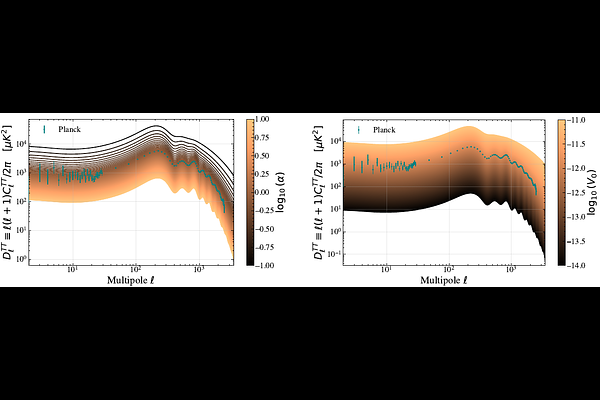
AbstractWe present a joint Bayesian analysis to impose constraints on the generalized $α$-Starobinsky inflationary model using the high-precision cosmological datasets: Planck, CMB lensing from ACT DR6, and Baryon Acoustic Oscillations (BAO) from DESI DR2. For the parameter inference, we introduce an alternative sampling approach. Rather than imposing priors on the cosmological parameters of the inflationary potential $(V_0, \, α, \, N_*)$, we place priors directly on the primordial physical observables $(A_s,\, n_s,\, r)$ through using analytical slow-roll consistency relations, our pipeline internally maps these sampled observables to the corresponding $α$-Starobinsky parameters. These values are then passed to a modified version of $\tt{CLASS}$, which solves the exact inflationary dynamics fully numerically. This pipeline ensures that the final reported posteriors for the observables are computed exactly, completely free from the slow-roll approximation. Applying this methodology, we explore the viability of the $α$-Starobinsky model. We show that, when the full combined dataset is considered, the pure Starobinsky model (i.e., the canonical limit $α= 1$) faces an apparent discrepancy: it requires a large number of $e$-folds of inflation after horizon crossing ($N_* > 60$) due to the shift in the scalar spectral index, $n_s$. In contrast, allowing the deformation parameter $α$ as a free parameter yields a clear $1σ$ preference for $\log_{10} α> 0$ present across all datasets. By favoring a broader inflationary plateau, the $α$-Starobinsky model elegantly reconciles theoretically sound expansion histories with empirical data. Notably, we also show that the addition of ACT DR6 lensing data introduces no significant impact on these primordial constraints, confirming that our robust posteriors are primarily driven by Planck and DESI measurements.