The effect of dust on vortices I: Laminar models

The effect of dust on vortices I: Laminar models
Nathan Magnan, Henrik Nils Latter
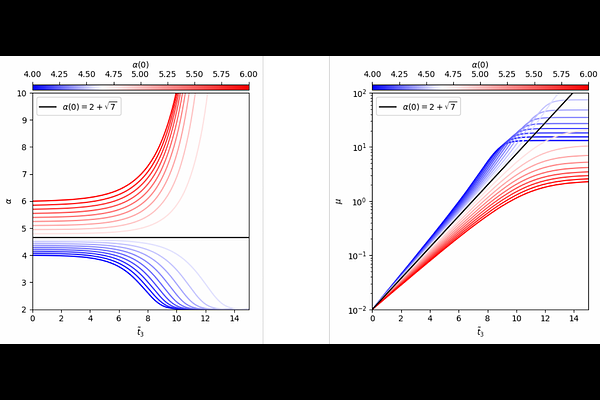
AbstractOne of the main questions regarding planet formation is how to cross the metre-scale barrier. Several theories rely on the formation of dust clumps dense enough to collapse under their own gravity. Vortices are promising candidate sites of clump formation because they can concentrate dust 'laminarly' by capturing particles, and 'turbulently' by creating the ideal conditions for the streaming instability. In this two-part series, we assess the validity of both pathways by investigating the effect of backreacting dust on vortices. This first paper focuses on the laminar pathway. We use multiple timescale analysis to create two models of vortex evolution. They differ in their assumptions regarding how much gas crosses the vortex's boundary: the first one assumes that the vortex's mass is constant, whereas the second one assumes that the gas density is constant. These two options epitomize the two ways in which vortices can respond to dust concentration. Essentially, as dust gets closer to the vortex centre, it loses angular momentum. To compensate, the gas must either move away from the vortex centre or change its vorticity (and therefore its shape). This choice neatly emerges from the conservation of a quantity akin to potential vorticity. Interestingly, we find that vortices that adjust their vorticity all evolve towards elliptically unstable shapes. And since the elliptical instability destroys the vortex, we conclude that dust imposes an upper bound on vortex lifetimes. If vortex destruction happens before the dust reaches the Hill density, the 'laminar' vortex pathway to planetesimal formation fails.