Bright Days Buffer Nighttime Light: Daytime Illumination Shapes Sex Differences in Sleep and Circadian Regulation

Bright Days Buffer Nighttime Light: Daytime Illumination Shapes Sex Differences in Sleep and Circadian Regulation
Wang, Y.; Chen, C. T.; DeBoer, T.; Block, G. D.; Paul, K. N.; Colwell, C. S.
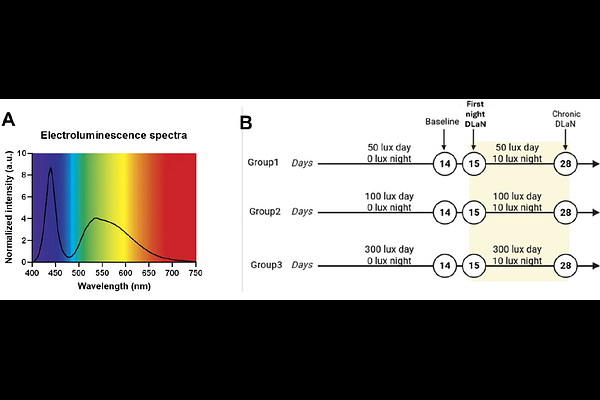
AbstractSex differences in sleep and wakefulness are well documented in humans but remain inconsistent in rodent studies, suggesting strong sensitivity to experimental context. In prior work, we observed no sex differences in sleep-wake architecture under relatively bright daytime light, raising the possibility that daytime illumination is a critical but underappreciated variable shaping sex-dependent sleep regulation. Here, we tested the hypothesis that daytime light intensity modulates sex differences in sleep-wake architecture and vulnerability to dim light at night (DLaN). Male and female C57BL/6J mice were exposed to acute (one night) or chronic (two weeks) DLaN (10 lux) under three daytime light intensities (50, 100, 300 lux). Sleep was assessed using electroencephalographic-based measures of vigilance states and slow wave activity (SWA). Dim daytime light (50 lux) unmasked robust sex differences in dark-phase sleep-wake architecture that were absent under brighter daytime light (300 lux). Acute DLaN reduced early-night wakefulness in both sexes under low daytime light but had minimal effect under bright daytime conditions. Following chronic DLaN, males exhibited reduced dim light phase wakefulness and dampened rhythm amplitude, whereas females showed pronounced phase shifts, rhythm attenuation, and altered timing of SWA under 50 and 100 lux. These changes were largely prevented under bright daytime light. Together, these findings identify daytime light intensity as a critical contextual factor governing sex specific regulation of sleep and vulnerability to nighttime light, providing a unifying framework to reconcile inconsistencies in the rodent sleep literature.