Azelaic Acid Exhibits Dual Antimicrobial and Quorum Sensing Inhibitory Activities Against Pathogens: In Vitro Evaluation and Molecular Docking Insights

Azelaic Acid Exhibits Dual Antimicrobial and Quorum Sensing Inhibitory Activities Against Pathogens: In Vitro Evaluation and Molecular Docking Insights
Arriaga, M. E.; Palacios-Rodriguez, A. P.; Martinez Gonzalez, G.; Ramirez-Villalva, A.; Almeida, J.
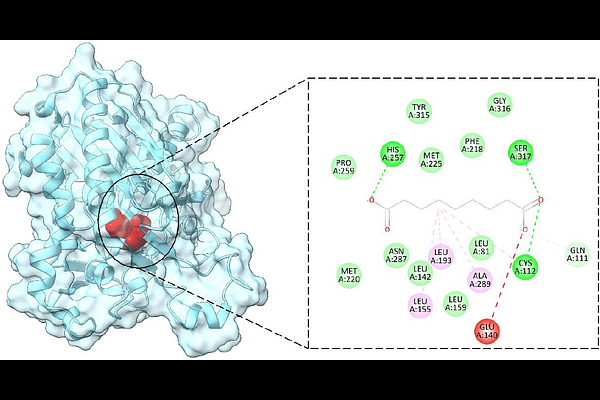
AbstractAbstract The emergence of antimicrobial resistance (AMR) has driven the search for alternative therapeutic strategies, including antivirulence approaches targeting bacterial quorum sensing (QS). Azelaic acid (AzA), a naturally occurring dicarboxylic acid with known antimicrobial properties, has not previously been characterized as a QS inhibitor in Gram-negative pathogens. This study evaluated the dual antimicrobial and antivirulence activity of AzA against reference strains and clinical isolates of Pseudomonas aeruginosa, Enterobacteriaceae, and Staphylococcus aureus through in vitro assays and molecular docking analyses. Minimum inhibitory concentration (MIC) values ranged from 250 to 1000 ug/mL, with lower MICs observed in clinical isolates of E. coli and S. aureus. Subinhibitory concentrations (250, 500 and 750 ug/mL) were used to assess QS-regulated virulence factors in P. aeruginosa, including pyocyanin, elastase, alginate, and protease production. AzA exhibited a significant, dose-dependent inhibition of all evaluated virulence factors across both reference and multidrug-resistant (MDR) and pan-drug-resistant (PDR) clinical strains (p < 0.001), achieving inhibition levels exceeding 90% in several cases, particularly for protease activity. Molecular docking analyses revealed that AzA interacts with key QS-related proteins (LasI, LasR, PqsD, and PqsR), showing moderate binding affinities (-5.3 to -6.5 kcal/mol) and stable interactions within conserved ligand-binding domains. These findings suggest a multitarget modulatory mechanism affecting interconnected QS pathways. Overall, this study demonstrates, for the first time, that AzA acts as a quorum sensing inhibitor in P. aeruginosa, attenuating virulence without directly affecting bacterial growth, highlighting its potential as a promising antivirulence therapeutic strategy.