Perturbations shift the composition of bacterial DNA carried by virus-like particles in the murine gut microbiome

Perturbations shift the composition of bacterial DNA carried by virus-like particles in the murine gut microbiome
Maier, J. L.; Callahan, B.; Duerkop, B. A.; Kleiner, M.
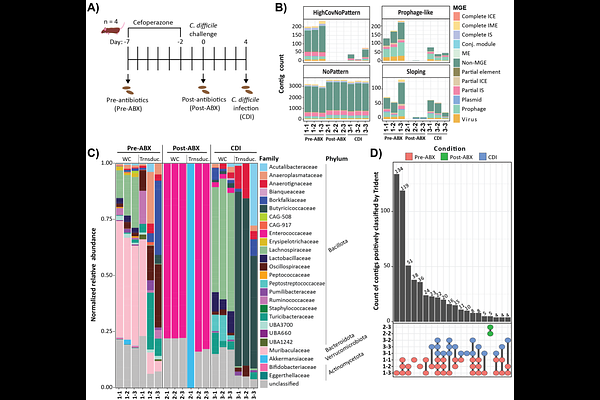
AbstractHorizontal gene transfer (HGT) is a driving force in microbial evolution that allows community members to rapidly evolve to cope with environmental stressors and competition. Despite the importance of HGT for the generation of genetic diversity, little is known about the specific mechanisms or dynamics of transfer in complex communities. Transductomics is a sequencing based technique which identifies potential HGT by bacteriophages (transduction) through sequencing of the transductome - the DNA carried by bacteriophages and other virus-like particles in a sample. We analyzed the murine gut transductome before and after perturbations with antibiotics and Clostridioides difficile infection (CDI). We found that several bacterial families - the Oscillospiraceae, Butyricoccaceae, and Turicibactericeae - disproportionally contributed to the transductome. Some families, like the Butyricicoccaceae, were frequent transducers in both the baseline and perturbed murine gut microbiome while other taxa displayed condition-specific transduction indicating that there may be specific transducing subpopulations or regulatory mechanisms controlling transduction frequency. Additionally, we found a diversity of highly abundant and enriched mobile genetic elements (MGEs) in the transductome including plasmids, integrative conjugative elements, phage satellites and transposons. The detection of MGEs containing conjugative elements suggest that some MGEs may spread through both transduction and conjugation. Overall, our work reveals a complex network of gene exchange occurring through transduction in the gut microbiome.