Specific determinants of the Transmembrane region of the Andes virus Gc glycoprotein drive the transition from membrane hemifusion to pore formation

Specific determinants of the Transmembrane region of the Andes virus Gc glycoprotein drive the transition from membrane hemifusion to pore formation
Marquez, C. L.; Villalon-Letelier, F.; Arata-Salas, G.; Tischler, N. D.
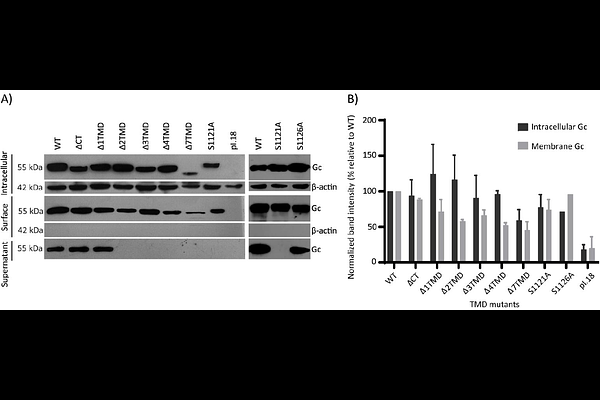
AbstractAndes virus (ANDV), a highly pathogenic orthohantavirus, enters host cells through low pH-triggered membrane fusion mediated by the Gc glycoprotein, a class II fusion protein containing a single C-terminal transmembrane domain (TMD). While the ectodomain has been extensively characterized, the role of the TMD in late-stage fusion remains unclear. Here, we investigated the minimal functional length and sequence requirements of the ANDV Gc TMD using site-directed mutagenesis. C-terminal deletion mutants and serine-to-alanine substitutions were evaluated for protein expression, virus-like particle production, cell-cell fusion, pseudotyped vector entry, and hemifusion activity. Deletion of the Gc cytoplasmic tail (CT) or a single C-terminal TMD residue was tolerated, whereas deletion of two or more residues impaired particle production and fusion, indicating that at least 21 of the 22 TMD residues are required for efficient membrane fusion and viral entry. Hemifusion assays showed that deletion of two or three residues, or substitution of the strictly conserved S1121, allowed lipid mixing but blocked progression to full fusion, while deletion of four residues also abolished hemifusion. In contrast, mutation of the less conserved S1126 had minimal effect. These results identify a precise TMD length and a conserved polar TMD residue as critical determinants of fusion pore formation in ANDV.