Chronoecological interactions: Temporal niche-switching by black-striped mice after agonistic food competition with a dominant sympatric mouse species

Chronoecological interactions: Temporal niche-switching by black-striped mice after agonistic food competition with a dominant sympatric mouse species
Stryjek, R.; d'Isa, R.; Parsons, M. H.; Szymanska, K.; Socha, K.; Chrzanowski, M.; Kurek, K.; Bebas, P.
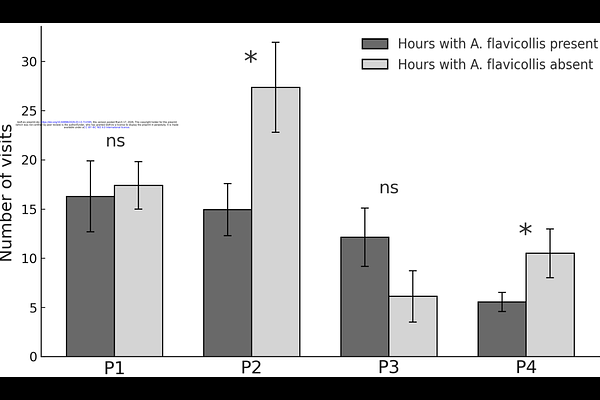
AbstractWhen novel nutrient-rich food sources become available to species sharing the same natural habitat, interspecies competition may arise, yielding insights into the ecological and social dynamics of the observed species. Here, we investigated food consumption patterns, and consequent social interactions, by two sympatric species of mice in response to a novel nutrient-rich food source. By deploying, in the mice's natural habitat, baited video-monitored chambers, we collected, over a 5-month period, 1805 observations of food visiting by Apodemus agrarius and Apodemus flavicollis. We also documented interspecific encounters, with 86.7% of the cases showing agonism. In these interspecies agonistic encounters, A. flavicollis was always the initiator of agonism, attacking within 2 sec in 92.3% of the cases, and being dominant over A. agrarius in 84.6%. Analysis of food visiting behavior revealed that, initially, both species preferred nocturnality. However, after the interspecies fights, A. agrarius switched its temporal preference to diurnality, leading to temporal niche segregation between the two species and a significant reduction of interspecies encounters. Moreover, A. agrarius demonstrated hour-specific avoidance of A. flavicollis, visiting significantly less in hours with A. flavicollis compared to hours without. Through temporal niche switching, A. agrarius managed to access the food source safely, without fights. In contrast, A. flavicollis remained consistently nocturnal across the entire study. Notably, our study presents the first 24h foraging actogram for free-living rodents. Moreover, while rodent interspecific competition is a well-known phenomenon, most of what we know about it comes from indirect observations. Direct observations of rodent interspecific interactions in nature are rare. Our work is the first direct (video-monitored) observation of temporal switch-inducing interspecies interactions in nature. As free-living rodents are currently considered a major model system for the study of interspecific competition, these results may offer precious insights for a better understanding of social dynamics, especially in asymmetric relationships. Furthermore, our findings highlight the significance of considering temporal dynamics in studies of interspecific interactions.