Kinetic Monte Carlo modeling of ammonium formate NH$_4^+$HCOO$^-$ and ammonium cyanate NH$_4^+$OCN$^-$ in interstellar ices

Kinetic Monte Carlo modeling of ammonium formate NH$_4^+$HCOO$^-$ and ammonium cyanate NH$_4^+$OCN$^-$ in interstellar ices
Joseph Salaris, Robin Toonen, Rens Waters, Herma Cuppen
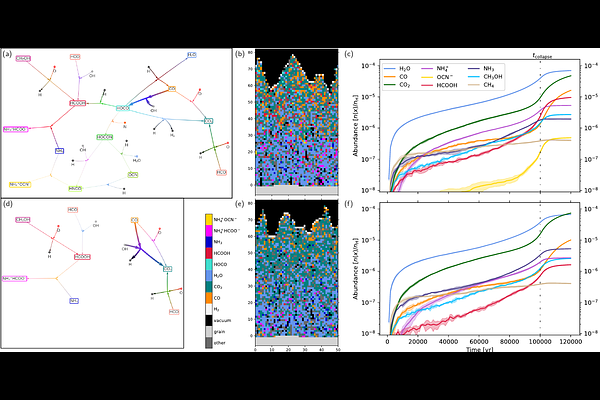
AbstractJWST observations have revealed evidence for NH$_4^+$ in the ices of the Chamaeleon I dark molecular cloud, with HCOO$^-$ and OCN$^-$ likely counter ions. Laboratory experiments have demonstrated that ammonium formate and ammonium cyanate can form through acid-base reactions involving NH$_3$ at cryogenic temperatures. The formation of these two ammonium salts are simulated to investigate their formation in dark-cloud ices and assess their sensitivity to uncertainties in the chemical reaction network, including the recently considered HOCO-mediated pathway for CO$_2$ formation, as well as variations in the cosmic-ray ionization rate, cloud collapse timescale and density, and elemental depletion. Our modeling framework consists of microscopic kinetic Monte Carlo (KMC) simulations of grain-surface chemistry augmented by UCLCHEM gas-phase and physical cloud evolution simulations. The microscopic KMC method provides for explicit simulation of the location, movement and reaction of ice species, making it particularly well-suited to model acid-base chemistry of NH$_4^+$-salt formation, occurring within the ice mantle over extended timescales. The simulations produce the canonical ice-evolution sequence, with an initially H$_2$O-rich ice followed by a layer dominated by CO and CO$_2$. Salt production is dominated by NH$_4^+$HCOO$^-$, which is found to form predominantly during the H$_2$O-rich stage as its production is limited by the availability of NH$_3$. NH$_4^+$OCN$^-$ is found to form later at the interface between the H$_2$O- and CO-rich ice when the formation of its precursor acid HNCO is enabled. Despite the variations explored, the total NH$_4^+$ abundance, particularly relative to H$_2$O, remains remarkably robust and consistent with the observed abundance. Depending on the variation, a redistribution between counterions HCOO$^-$ and OCN$^-$ is observed.