Carbon and nitrogen availability affect biofilm growth and morphology of the extremotolerant fungus Knufia petricola

Carbon and nitrogen availability affect biofilm growth and morphology of the extremotolerant fungus Knufia petricola
Dehkohneh, A.; Schumacher, J.; Cockx, B. J. R.; Keil, K.; Camenzind, T.; Kreft, J.-U.; Gorbushina, A. A.; Gerrits, R.
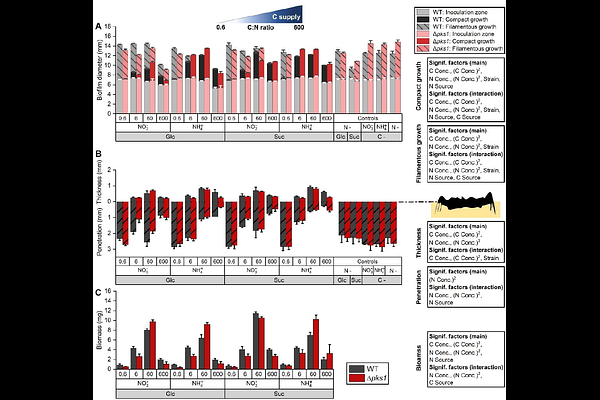
AbstractRock-inhabiting fungi thrive in subaerial oligotrophic environments such as desert rocks, solar panels and marble monuments where organic carbon and nitrogen are scarce. We tested whether the rock-inhabiting fungus Knufia petricola showed a preference regarding nitrogen (NO3- or NH4+) and carbon (glucose or sucrose) sources and whether it was sensitive towards carbon and nitrogen limitation. As this fungus produces the carbon-rich, nitrogen-free 1,8-dihydroxynaphthalene (DHN) melanin, we tested whether a melanin-deficient mutant would be less sensitive to carbon limitation. The carbon and nitrogen concentrations were the primary predictors of growth, with a broad optimum partially explained by an optimal fungal C:N ratio. Limiting carbon or nitrogen supply decreased biomass formation, CO2 production and biofilm thickness but promoted substratum penetration through filamentous growth. The nitrogen content of the biomass was flexible within limits, increasing upon increasing nitrogen supply or decreasing carbon supply. The carbon use efficiency was fairly constant, whereas melanization correlated with a higher nitrogen content of the biomass despite melanin being nitrogen-free. In conclusion, in vitro, K. petricola switches to explorative growth under nutrient limitations, like fast-growing fungi, revealing universal fungal resource-acquisition patterns.