Growing Planets Produce Extreme Dust Signatures

Growing Planets Produce Extreme Dust Signatures
Philip J. Carter, Zoë M. Leinhardt
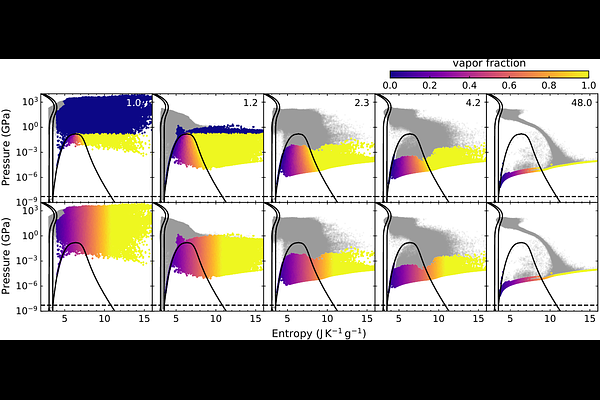
AbstractCollisions between planetary bodies are essential to the assembly of rocky planets like the Earth, but they are extremely difficult to observe. We therefore rely on indirect signatures of planetary impacts such as extreme debris disks - bright infrared excesses around other stars. Extreme debris disks are thought to be the result of energetic collisions that ejected large amounts of vaporized rock which rapidly condensed into mm- or cm-sized dust. However, previously there has been no clear way to relate the observed mass of dust to the collision that produced it. Here, we show that the colliding bodies required are orders of magnitude more massive than the mass of dust observed. We find that more massive extreme debris disks require proportionally larger colliding bodies. As a consequence, the most massive observed extreme debris disks require collisions of Mars- to Earth-mass bodies. Extreme debris disks thus reveal the ongoing formation of rocky planets comparable in size to the rocky planets of our own solar system.