Supermassive Black Hole Assembly from Heavy Seeds with Dynamical Friction in the BRAHMA Simulations: Implications for JWST, LISA, and the Local Universe

Supermassive Black Hole Assembly from Heavy Seeds with Dynamical Friction in the BRAHMA Simulations: Implications for JWST, LISA, and the Local Universe
Aklant K. Bhowmick, Laura Blecha, Paul Torrey, Luke Zoltan Kelley, Rachel S. Somerville, Rainer Weinberger, Priyamvada Natarajan, Tiziana Di Matteo, Lars Hernquist, Mark Vogelsberger, Alex M. Garcia
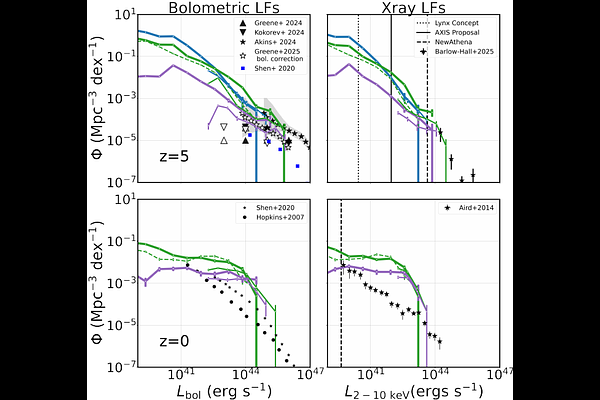
AbstractThe JWST discoveries of supermassive black holes (BHs) at $z \gtrsim 5$ may provide key insights into their seeding origins. Using new $[18{-}72~\rm Mpc]^3$ BRAHMA cosmological simulations, we investigate how variations in heavy-seed prescriptions, coupled with a subgrid dynamical friction model, shape BH populations at $z \sim 5$ and $z \sim 0$. We consider two "lenient'' seed models, in which all halos containing sufficient dense & metal-poor gas form $\sim10^4$ and $\sim10^5~M_{\odot}$ seeds, and a "strict'' seed model, in which $\sim10^5 M_{\odot}$ seeds form only under additional constraints motivated by direct collapse black hole formation. By $z \sim 5$, all models produce $M_*-M_{\rm BH}$ relations broadly consistent with the observed local Universe for $M_*\gtrsim10^9~M_{\odot}$ galaxies, but only the lenient scenarios generate systems near the upper envelope of the observed local scatter. In galaxies hosting $M_{\rm BH} \sim 10^8$-$10^9~M_{\odot}$ BHs, lenient production of $\sim10^5~M_{\odot}$ seeds also produces multiple overmassive systems with $M_{\rm BH}/M_* \gtrsim 0.01$. Although their growth is dominated by seeding and mergers, these systems reach luminosities of $\sim10^{43}$-$10^{45}\mathrm{erg s^{-1}}$, comparable to those inferred for JWST-detected BHs. As a key observational signature, the lenient seed models yield merger rates of $\gtrsim100\mathrm{yr^{-1}}$ and near-unity local BH occupation fractions even in galaxies with $M_* \lesssim 10^7~M_{\odot}$. In contrast, the strict seed model produces merger rates of only $\sim1\mathrm{yr^{-1}}$ and local occupation fractions of $\lesssim10\%$ for galaxies with $M_* \lesssim 10^8~M_{\odot}$. Future gravitational-wave event rates and measurements of local BH occupation fractions will therefore provide strong constraints on the dominant pathways responsible for high-redshift BH assembly.