Autonomous Orbit Determination Analysis of a Conceptual Cislunar Navigation Constellation based on Inter-Satellite Range Measurement

Autonomous Orbit Determination Analysis of a Conceptual Cislunar Navigation Constellation based on Inter-Satellite Range Measurement
Haohan Li, Yuxuan Miao, Xiyun Hou, Bosheng Li, Jinjun Zheng, Hao Yu, Kanglian Zhao, Huan Yan
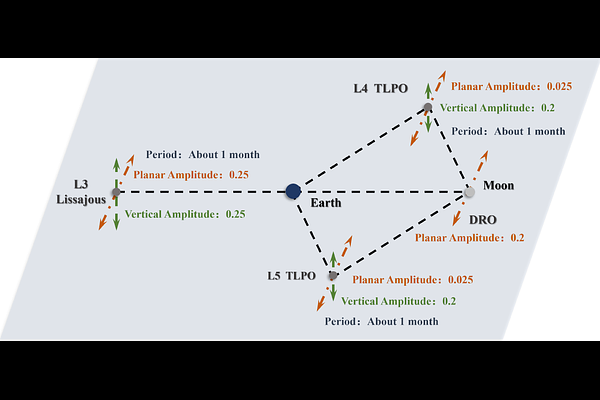
AbstractWith the community's increasing interest in the cislunar space, building a navigation constellation servicing the whole cislunar space has become a pressing need. Previous studies mainly focus on constellations using orbits close to the Moon, which limits the servicing volume of the constellation. In this work, a four-satellite constellation using one L3 orbit, one L4 orbit, one L5 orbit and an orbit close to the Moon is proposed. The orbit determination accuracy is an important factor to be considered when designing parameters of the constellation. In this study, the mode of autonomous orbit determination (AOD) based on inter-satellite range data is considered. With such a model, the out-of-plane design parameters are identified as the main parameters influencing the AOD accuracy. For the AOD based on short arcs, we find that the increase of the out-of-plane amplitude can improve the AOD accuracy, and the out-of-plane initial phases have a more complex influence. A novel relative planarity factor (RPF) $P_\text{r}$, which has negative correlation with the AOD accuracy, is proposed as the metric to evaluate the variation of AOD performance. Using $P_\text{r}$, we demonstrate that the coplanarity of the constellation can significantly reduce the AOD accuracy. For the long arc AOD, the influence of different parameters is insignificant.