Planetesimal-Driven Instabilities in Resonant Chains of Cold Neptunes and Their Dynamical Outcomes

Planetesimal-Driven Instabilities in Resonant Chains of Cold Neptunes and Their Dynamical Outcomes
Ryan LoRusso, Cristobal Petrovich, Hareesh Gautham Bhaskar
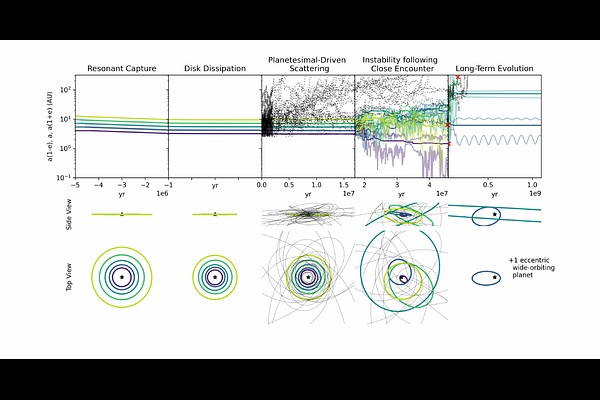
AbstractCold Neptunes and sub-Neptunes are among the most common products of planet formation and likely dominate the angular-momentum budgets in most planetary systems, yet their dynamical impact on planetary architectures remains poorly understood. Using N-body simulations, we investigate the evolution of multi-Neptune systems assembled into resonant chains during the gas-disk phase and later coupled to remnant planetesimal disks. We show that planetesimal disks containing $\simeq 1$-$4\%$ of the planetary mass efficiently disrupt resonant chains and trigger global dynamical instabilities on timescales of $1~\mathrm{Myr}$-$1~\mathrm{Gyr}$, providing a pathway for delayed instability long after gas-disk dispersal, albeit with instability timescales that are highly sensitive to disk mass. The ensuing instability drives large-scale orbital rearrangement and loss of planets through collisions, tidal disruption, and ejections. Notably, in most systems at least one planet is scattered inward to $\sim 0.1~\mathrm{au}$ on $\sim 10$-$100$ Myr timescales (for $\sim 5$-$50\; M_\oplus$ planets) following instability onset, with a substantial fraction undergoing tidal capture or disruption. This tidal capture can provide a natural pathway to hot Neptune formation, while compact inner chains, if present, would be destroyed on $\sim 100~\mathrm{Myr}$ timescales by cold sub-Neptunes, naturally explaining the observed decline in the resonant fraction. We argue that the predictions of our model, which yields mass-segregated planets and corresponding relative abundances of cold, wide-orbit, and free-floating planets, can be tested by ongoing and upcoming microlensing surveys.