Applying advanced circular statistics: magnetic orientation of green toad larvae

Applying advanced circular statistics: magnetic orientation of green toad larvae
Helfenbein, P. M.; Muheim, R.; Spiessberger, M.; Burgstaller, S.; Landler, L.
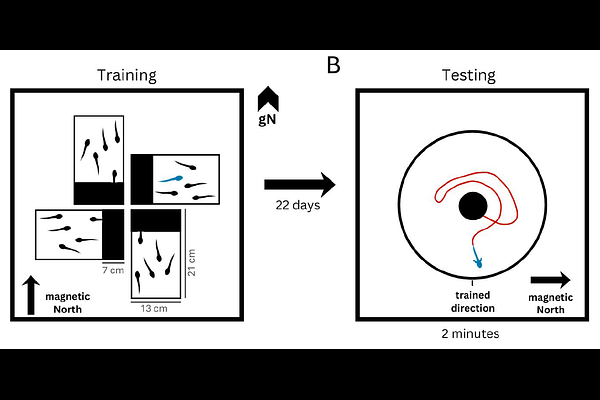
AbstractMany animals use the Earth`s magnetic field as a directional reference, for long-distance, but also for local movements. Among those are amphibians which can be trained along the y-axis (the shore-deep gradient) in their aquatic environment. We used a light gradient (light-dark axis) to train larvae of the European green toad (Bufotes viridis) towards a magnetic direction, testing their magnetoreception ability. After training we tested the individual animals four times, in the four cardinal magnetic field directions (N, E, S, W). Recent developments in circular statistics allowed us to use the larvae`s responses in a mixed effects models (the individual as the random factor) and tease the overall and individual responses apart. We used control simulations to test whether the mixed effects models could produce false positive findings, which confirmed the validity of this approach. Our results clearly show a trained magnetic compass response for the green toad, adding another animal to the list of magnetoreceptive animals. Interestingly, when analyzing just the first choice after release, there was only a magnetic effect. However, over the course of the entire 2 minutes trial, animals also showed untrained magnetic as well as non-magnetic responses, highlighting the complexity of small-scale animal orientation, with many interacting cues and motivations. Switching to repeated measures experimental design together with the newly developed circular statistical approaches can therefore be used to better understand the entirety of the animal orientation strategies, going beyond the overall effect. Our approach has the potential to study different aspects of animal orientation in the same experiment (i.e., magnetic alignment and trained magnetic effects) and therefore bridge the gaps between different lines of research.