The impact of Hawking radiation from primordial black holes on recombination and the Hubble tension

The impact of Hawking radiation from primordial black holes on recombination and the Hubble tension
Adam Batten, Jeremy Mould
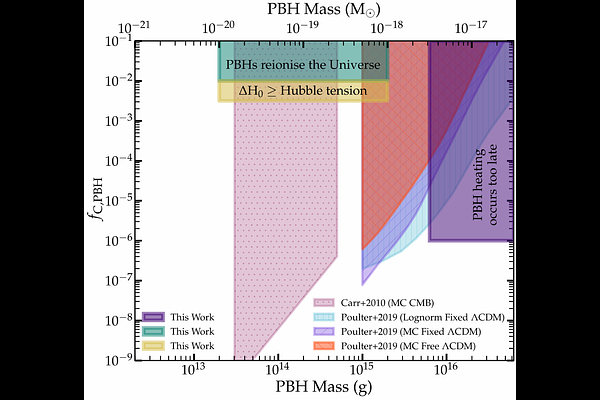
AbstractPrimordial black holes (PBHs) evaporate through Hawking radiation, emitting high-energy photons and ionising their surrounding environment. As contributors to the density of dark matter, Omega_C, if 10^-18 solar mass PBHs are present in the Universe they delay recombination and move the surface of last scattering of the cosmic microwave background (CMB). We perform recombination simulations using the software Recfast, and calculate the PBH fraction of dark matter required to resolve the Hubble tension. We find that nominally a cosmic PBH energy density of Omega_PBH ~ 10^-3 Omega_C would cause an 8.9% increase in the value of H_0, enough to entirely reduce the tension between the early- and late-time observations. This PBH fraction is modified by Gray Body Factors affecting Hawking radiation. Furthermore, also fitting the CMB leaves the Hubble tension not fully relieved with our present PBH prescription. Until relevant non-gravitational properties of the dominant dark matter species are ruled out, we suggest that the hypothesis that the ionisation history of the universe matches the thermal history of the standard LCDM cosmology is too precarious to hang the expansion rate on, and that it is better to measure H_0 locally at z <~ 1.