When turbulence beats magnetism: origin of massive star cluster seeds

When turbulence beats magnetism: origin of massive star cluster seeds
Junhao Liu, Patricio Sanhueza, Piyali Saha, Kaho Morii, Josep Miquel Girart, Qizhou Zhang, Fumitaka Nakamura, Paulo C. Cortes, Valeska Valdivia, Benoit Commercon, Patrick M. Koch, Kate Pattle, Xing Lu, Janik Karoly, Manuel Fernandez-Lopez, Ian W. Stephens, Huei-Ru Vivien Chen, Chi-Yan Law, Keping Qiu, Shanghuo Li, Henrik Beuther, Eun Jung Chung, Jia-Wei Wang, Fernando A. Olguin, Yu Cheng, Jihye Hwang, Sandhyarani Panigrahy, Chakali Eswaraiah, Maria T. Beltran, Qiuyi Luo, Spandan Choudhury, Ji-hyun Kang, Wenyu Jiao, Luis A. Zapata, A. -Ran Lyo
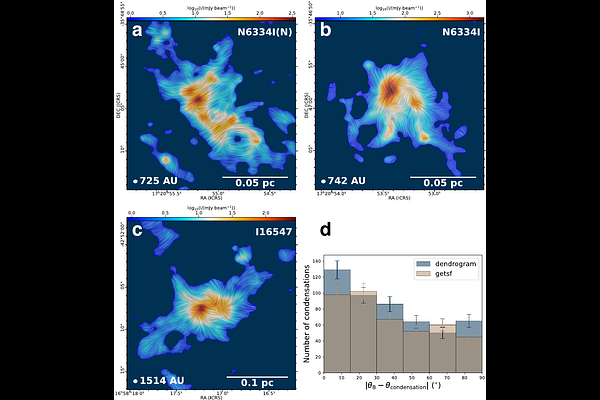
AbstractHigh-mass stars form in protoclusters, where gravo-magnetic processes shape collapsing clouds and clumps to be elongated preferentially perpendicular to magnetic (B) fields. Yet it remains unclear whether gravo-magnetic processes still govern the formation of smaller-scale condensations in massive-star-forming protoclusters, which are crucial for understanding the stellar initial mass function and multiplicity. Here we report the first statistical evidence that the condensation elongations are preferentially aligned with local B fields, based on high-resolution data from the largest dust polarization survey toward 30 massive star-forming regions with the Atacama Large Millimeter/submillimeter Array (ALMA). Our clustered massive star formation simulations reveal that this more parallel alignment is exclusively observed in models where initial turbulence dominates B fields. In contrast, models with initial B fields dominating turbulence distinctly exhibit a more perpendicular alignment. The comparison between observations and simulations suggests that turbulence could play a more important role than B fields in the formation of condensations in the context of clustered massive star formation, contradicting the prediction of classical magnetically regulated models. Moreover, we find a possibly turbulence-induced preferential misalignment between the B field and rotation axis of condensations, which may potentially reduce the magnetic braking efficiency and facilitate the formation of large protostellar disks.