Tracking Inflammation and Fibroblast Activation in Hypertensive Heart Failure Across the Cardio-Renal Axis

Tracking Inflammation and Fibroblast Activation in Hypertensive Heart Failure Across the Cardio-Renal Axis
Strunk, M.; Hess, A.; Gutberlet, M.; Willmann, M.; Ross, T. L.; Bengel, F. M.; Thackeray, J. T.
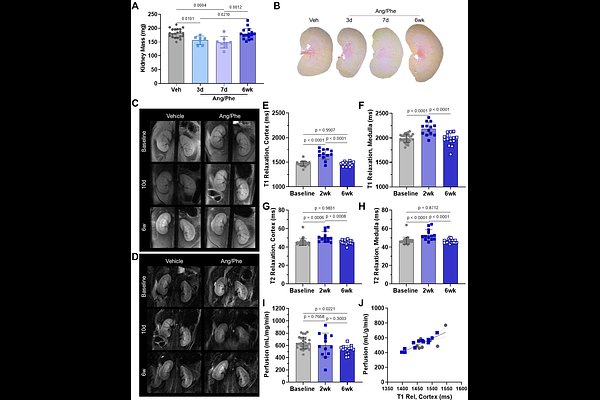
AbstractHypertension and heart failure are associated with increased risk of chronic kidney disease. Cardiorenal syndrome is characterized by excessive systemic inflammation and progressive fibrosis. We hypothesized that transient hypertension in mice due to infusion of angiotensin II and phenylephrine (Ang/Phe) would induce parallel immune cell and fibroblast activation in both the heart and kidney, where the intensity of inflammation and fibroblast activity would predict decline in function of both organs. Adult male C57Bl/6N mice were randomized to receive 7d infusion of either Ang/Phe (n=41) or vehicle (n=27) by subcutaneous osmotic minipump. Despite removal of minipumps at 7d, Ang/Phe mice displayed persistent myocyte hypertrophy, interstitial fibrosis, and modestly reduced systolic function to 6 weeks. Molecular imaging of chemokine receptor CXCR4 using 68Ga-pentixafor at 3d of Ang/Phe infusion revealed transient inflammation in the left ventricle. Imaging of fibroblast activation protein (FAP) revealed diffuse fibroblast activity in the left ventricle. Both imaging signals predicted subsequent functional decline. Magnetic resonance imaging of the kidney revealed transient prolongation of T1 relaxation in at 2 weeks after Ang/Phe infusion that returned to normal by 6wk, despite a progressive reduction in renal perfusion. CXCR4 and FAP PET displayed no change in kidney inflammation or fibroblast activation. Comparison of imaging data described a direct correlation between cardiac and renal CXCR4 PET signal at 3d and FAP PET signal at 7d. The intensity of cardiac inflammation correlated with subchronic fibrosis in the kidney cortex. Total body molecular imaging enables simultaneous evaluation of the immune-fibrosis network in heart-kidney crosstalk after short term hypertension and may provide valuable guidance of novel therapies.