A mathematical synthesis of genetics, development, and evolution

A mathematical synthesis of genetics, development, and evolution
Gonzalez-Forero, M.
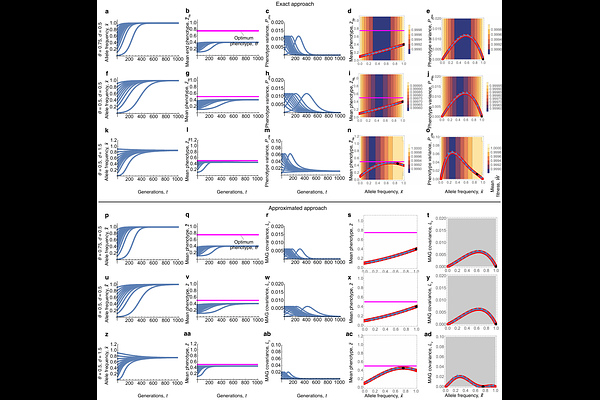
AbstractMathematically integrating genetics, development, and evolution is a longstanding challenge. Here I develop general mathematical theory that integrates sexual, discrete, multilocus genetics, development, and evolution. This yields an exact method to describe the evolutionary dynamics of allele frequencies and linkage disequilibria in multilocus systems and the associated evolutionary dynamics of mean phenotypes constructed via arbitrarily complex developmental processes. The theory shows how development affects evolution under realistic genetics, namely by shaping the fitness landscape of allele frequencies and linkage disequilibria and by constraining adaptation to an admissible evolutionary manifold (high dimensional region on the landscape) where mean phenotypes, phenotype (co-)variances, and higher moments can be developed. I derive a first-order approximation of this exact method, which yields equations in gradient form describing change in allele frequency, linkage disequilibria, and mean phenotypes as constrained, sometimes-adaptive topographies. Both the exact and approximated equations describe long-term phenotypic and genetic evolution, including the evolution of mean phenotypes, phenotype covariance matrices, "mechanistic" additive genetic cross-covariance matrices, and higher moments. I provide worked examples to illustrate the methods. The theory obtained is referred to as evo-devo dynamics, which can be interpreted as an extension of population genetics, with some similarities to quantitative genetics but with fundamental differences. The theory provides tools to re-assess empirical observations that have been paradoxical under previous theory, such as the maintenance of genetic variation, the paradox of stasis, the paradox of predictability, and the rarity of stabilising selection, which appear less paradoxical in this theory.