Stream-Driven Ignition of a Realistic Undisturbed Helium Shell on a White Dwarf

Stream-Driven Ignition of a Realistic Undisturbed Helium Shell on a White Dwarf
Nethra Rajavel, Dean M. Townsley, Ken J. Shen
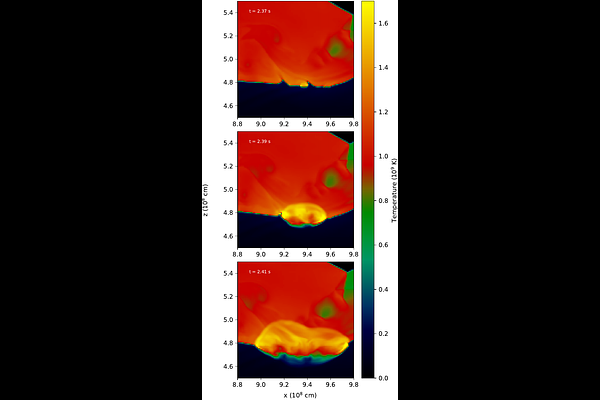
AbstractThe dynamically driven double degenerate double detonation (D$^6$) model has emerged as a promising progenitor scenario for Type Ia supernovae. In this model, a carbon-oxygen white dwarf (WD) in a close double WD binary undergoes a double-detonation triggered by dynamical mass transfer from its companion. The mass transfer stream directly impacts the surface of the primary WD, potentially igniting a helium detonation in the surface layer. The resulting shock converges in the core, triggering a carbon detonation that ultimately unbinds the star. While previous studies have demonstrated the viability of this mechanism, the conditions under which the helium shell ignites remain uncertain. We perform two-dimensional simulations using FLASH to study helium detonation ignition driven by stream impact on a carbon-oxygen WD with a realistic, unmixed composition profile left at the end of the previous helium-shell burning phase before the WD was formed. We model WDs with masses of 0.8, 0.9, and 1.0 $,M_\odot$ and vary stream properties for each case. We find that stream impact leads to helium ignition in all cases, with ignition occurring at varying distances from the impact point. Ignition consistently occurs near the core-shell transition, highlighting the importance of a realistic WD profile. However, the ignition mechanism differs between models and can arise from interactions of neighboring hot, mixed regions rather than a single point. Ultimately, all models but one sustain a propagating detonation capable of traversing the WD surface further reinforcing the viability of the D$^6$ model as a progenitor scenario for Type Ia supernovae.