Viscously Stirring Particle Disks into Lorentzians and Gaussians to Infer Dynamical and Collisional Masses (ARKS XIII)

Viscously Stirring Particle Disks into Lorentzians and Gaussians to Infer Dynamical and Collisional Masses (ARKS XIII)
Eugene Chiang, Tim D. Pearce, Marija R. Jankovic, Alexander Jeffrey Backues, Yinuo Han, Alexander V. Krivov, Margaret Pan, Brianna Zawadzki, A. Meredith Hughes, Krish Prakash Jhurani, Joshua B. Lovell, Sebastian Marino, Antranik A. Sefilian, David J. Wilner, Mark C. Wyatt, Sebastian Perez, Peter Abraham, Agnes Kospal, Patricia Luppe
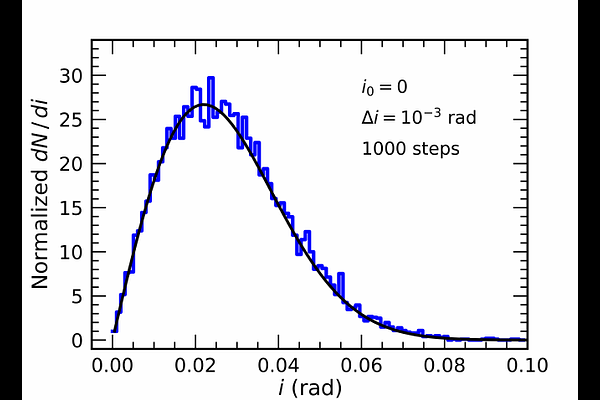
AbstractDisks (Keplerian or otherwise, particulate or fluid) are often assumed to have densities that drop off vertically as Gaussians. Recent mm-wave imaging of circumstellar debris disks contradicts this assumption, revealing vertical profiles in dust that resemble Lorentzians. As part of the ARKS ALMA Large Program, we calculate how Lorentzians and Gaussians define an evolutionary sequence for disks of gravitationally scattering (viscously stirring) particles. When orbits are crossing and eccentricities $e \gg$ inclinations $i$, each scattering changes a particle's inclination by $\pm \,Δi \propto i$. A random walk with fixed steps in $Δi/i = Δ\ln i$ produces a log normal $i$ distribution, whose thick tail at large $i$ leads to thick Lorentzian tails in density. This result holds independent of the origin of the large eccentricities; what matters is that relative motions parallel to the disk midplane are faster than perpendicular motions. After enough scatterings, $i$ comes into equipartition with $e$, $Δi$ stops exponentiating, and the vertical density profile relaxes to a Gaussian. We estimate the numbers and masses of perturbers needed to stir themselves and observable dust grains in Lorentzian and Gaussian debris disks imaged by ARKS. The big bodies may be sufficiently few in number as to be collisionless, in which case their masses range from the Moon to several Earths. But if Pluto-sized or smaller, the big body stirrers may be so numerous and collide so frequently that they can source the collisional cascades that produce observable dust.