Conservation Blind Spot: The Critical Role of Larval Stage in Assessing Extinction Risk

Conservation Blind Spot: The Critical Role of Larval Stage in Assessing Extinction Risk
Song, Y.-F.; Wang, Y.-L.; Yuan, Z.-Y.; Li, Q.-Q.; Zhou, W.-W.
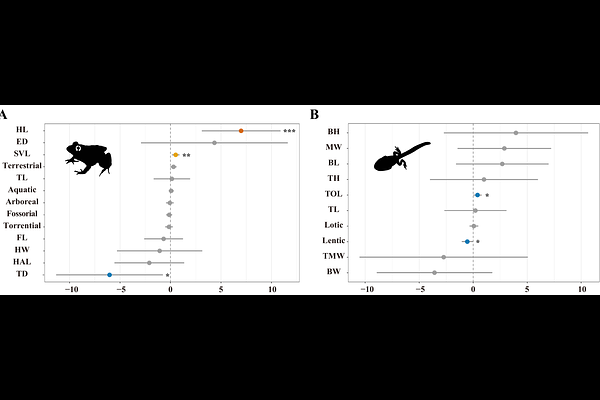
AbstractIn an era of severe global biodiversity threats, understanding the link between species' traits and their endangerment helps uncover causes of risk and infer threats to understudied species. Most animals have complex life cycles with distinct stages that may face stage-specific threats. Current conservation frameworks rely heavily on adult traits, potentially misjudging extinction risk. Using Chinese anurans as a model, we integrated functional traits from both adult and tadpole stages to examine their association with extinction risk. We found that body size positively correlates with risk in both stages. Microhabitat use related with extinction risk in tadpoles but shows no significant link in adults. Adult relative tympanum diameter and head length also correlate with extinction risk. These results indicate that species vulnerability is shaped by multi-stage traits, with both shared and stage-specific threats. Conservation based solely on adult traits may fail to accurately assess species threats. We call for integrating a whole-life-history perspective into biodiversity assessment and conservation to more effectively address the global biodiversity crisis.