Cortical Activity During Sustained Isometric Ankle Contractions Following Chronic Sleep Restriction: A High-Density EEG Study

Cortical Activity During Sustained Isometric Ankle Contractions Following Chronic Sleep Restriction: A High-Density EEG Study
Seynaeve, M.; Samogin, J.; Mantini, D.; de Beukelaar, T.
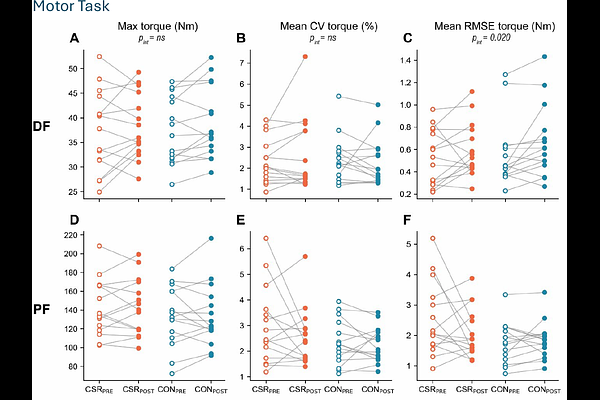
AbstractBackground: Chronic sleep restriction (CSR) impairs cognitive function, but its effects on the cortical dynamics underlying active motor performance remain poorly understood. High-density EEG provides a means to examine task-related oscillatory activity across sensorimotor and attentional networks during movement. Methods: Fifteen healthy males completed a randomized crossover study involving a CSR condition (five hours sleep per night for four nights) and a control condition (normal sleep). Before and after each intervention, participants performed sustained isometric ankle contractions at 40% of their maximal force while EEG was recorded. Source-reconstructed event-related desynchronization (ERD) was computed across theta, alpha, beta, and gamma bands in the sensorimotor network and dorsal attention network. Sustained attention was assessed with the Psychomotor Vigilance Task (PVT) and perceived workload with the NASA Task Load Index. Results: CSR successfully reduced sleep duration by 2.36 hours on average (p < .001). Following CSR, PVT reaction times increased significantly ({Delta} = +31 ms, p = .002) and attentional lapses increased ({Delta} = +9.87, p < .001). CSR produced a significant overall increase in ERD across bands, networks, and movement directions (F(1, 5713) = 14.20, p < .001). This effect was present in both the sensorimotor and dorsal attention networks. The ERD increase was specific to dorsiflexion and absent during plantarflexion (condition x session x movement direction: F(1, 5713) = 9.13, p = .003). Subjective mental demand increased following CSR (p = .027), while objective motor performance was largely unimpaired. Conclusion: CSR increased broadband ERD during dorsiflexion across both sensorimotor and attentional networks, alongside impaired sustained attention and greater perceived mental demand. As motor performance was largely preserved, this increased ERD may reflect compensatory neural recruitment under sleep pressure.