Using a planted tree biodiversity experiment to evaluate imaging spectroscopy for species classification

Using a planted tree biodiversity experiment to evaluate imaging spectroscopy for species classification
van Moorsel, S. J.; Schmid, B.; Niederberger, M.; Huggel, J.; Scherer-Lorenzen, M.; Rascher, U.; Damm, A.; Schuman, M. C.
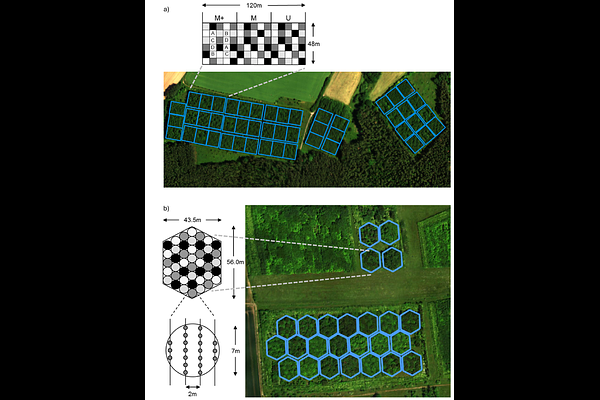
AbstractField-based monitoring of tree species in forests is often sparse due to logistical constraints. Remote sensing enables repeated, spatially contiguous collection of reflectance data across large areas. Tree species classification accuracy using such data is variable, likely because most studies use observational datasets where species occurrence correlates with environmental variation. We used two sites of a tree biodiversity experiment in Germany (BIOTREE: Kaltenborn and Bechstedt), where different species have been planted with high replication under controlled diversity levels, to assess how well tree species could be classified using reflectance data from airborne imaging spectroscopy and different classification methods (linear discriminant analysis, LDA, and a non-linear support vector machine, SVM). Reflectance data for 589 wavelengths between 400-2400nm were acquired at 1m spatial resolution during peak growing season. Reflectance spectra showed large and significant variation between taxonomic classes, orders, and species, and weak, but still significant, interactions between classes or orders and diversity levels. Classification accuracy reached 100% in training datasets, 77%-83% for the four species in Kaltenborn prediction datasets, and 31%-49% for the 16 species in Bechstedt prediction datasets. LDA provided more accurate predictions than SVM; and using similarly-spaced original wavelengths with LDA was as efficient as using principal components derived from the original data. While airborne imaging spectroscopy effectively distinguished up to four tree species in our datasets, classification accuracy was lower in more species-rich plots. In these cases, the methodology may be more useful for functional diversity monitoring than for tree species classification.